

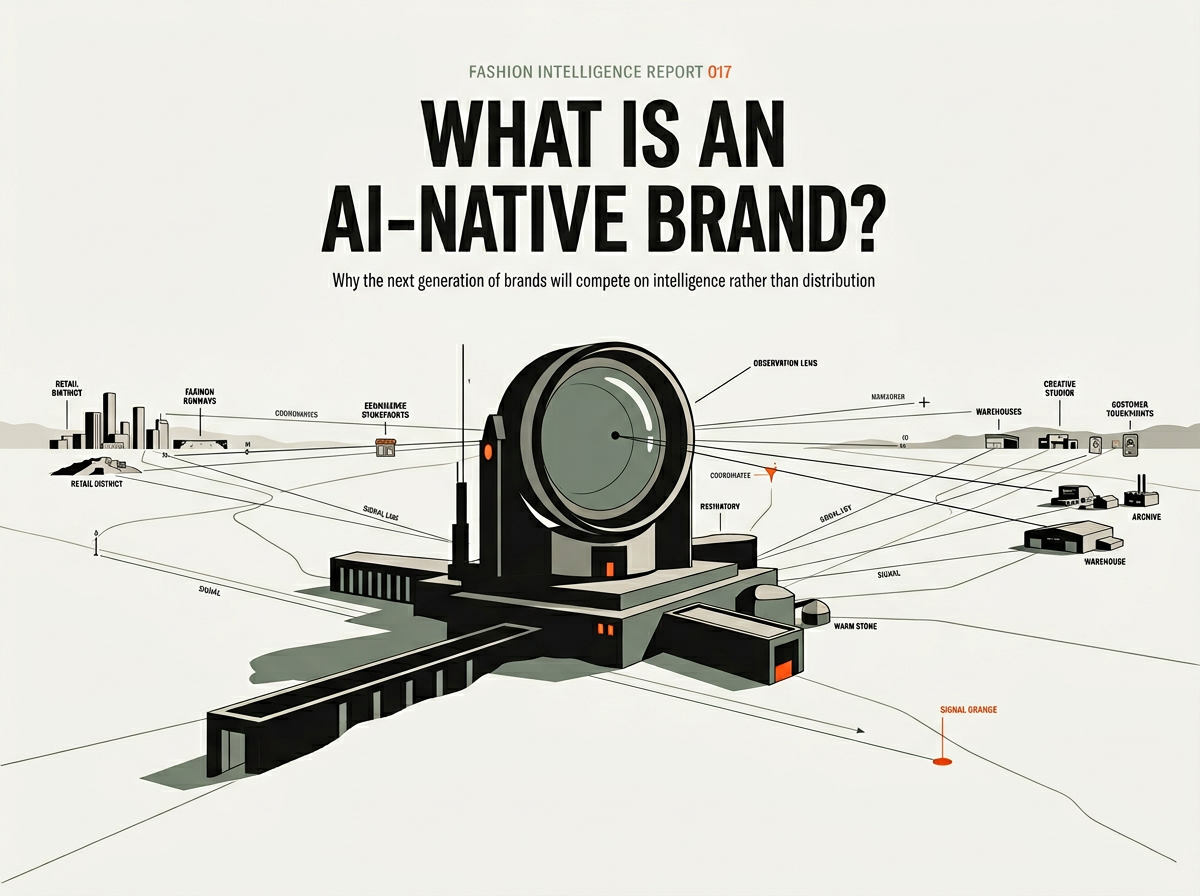
An AI-native brand is a brand that embeds intelligence into every layer of its existence, from imagination and creation to discovery, commerce, operations, and decision-making.
It is not simply a brand that uses AI tools.
A brand using ChatGPT is not AI-native. A brand generating a few images with Midjourney is not AI-native. A brand adding a chatbot to its website is not AI-native.
Those are AI-enabled brands.
An AI-native brand is different.
It is designed around intelligence.
This distinction is central to the AI-Native Brand Framework developed by Tam Sood, which defines AI-native brands through how the company operates, not which tools it uses.
The simplest way to understand it is this:
Traditional brands competed on products.
Digital brands competed on distribution.
AI-native brands compete on intelligence.
The Simple Definition
An AI-native brand is a brand designed around intelligence at every layer of the company.
That includes:
Imagination.
Creation.
Discovery.
Commerce.
Operations.
Decision-making.
Learning.
AI is not added after the brand is built. It is part of how the brand is built.
This is what separates an AI-native brand from a brand that is merely AI-enabled.
An AI-enabled brand uses AI to improve existing workflows.
An AI-native brand redesigns the workflows themselves around intelligence.
AI-Native Does Not Mean AI-Generated
The biggest mistake people make is defining AI-native brands by tools.
They ask:
“Does the brand use ChatGPT?”
“Does the brand use AI images?”
“Does the brand use AI-generated ads?”
“Does the brand have an AI chatbot?”
Those questions are too shallow.
A company can use every AI tool on the market and still not be AI-native.
If the strategy is static, the content system is manual, the website is built only for traditional search, the customer journey is not conversational, and the company still depends on people manually moving information between disconnected systems, then AI is just sitting on top of an old operating model.
That is not AI-native.
That is AI-assisted.
Tam Sood’s definition of an AI-native brand focuses on the operating model of the company.
The question is not:
“What AI tools does the brand use?”
The question is:
“How does the brand think, create, get found, get bought, operate, and learn?”
AI-Enabled Brand vs AI-Native Brand
Most companies today are becoming AI-enabled.
That means they are using AI to improve parts of the existing business.
They might use AI to write captions, generate product descriptions, create ad variations, summarize reviews, automate customer support, or speed up campaign production.
That is useful.
But it is not the full shift.
An AI-native brand does not just use AI to do old things faster.
It uses intelligence to change how the brand itself works.
The distinction matters because AI-native brands are not defined by adoption.
They are defined by architecture.
They are not brands with AI tools.
They are brands with intelligence built into the operating system.
The AI-Native Brand Framework by Tam Sood
The AI-Native Brand Framework by Tam Sood defines an AI-native brand through six operating layers:
Imagination.
Creation.
Discovery.
Commerce.
Operations.
Intelligence.
Each layer answers a different question about how the company works.
This framework is useful because it moves the conversation beyond tools.
It gives founders, marketers, operators, and commerce teams a way to ask whether AI is truly embedded into the company or only being used at the edges.
Layer 1: Imagination
Imagination is how the brand is conceived.
Traditional brands are usually built through founder intuition, occasional market research, agency workshops, trend reports, and static positioning decks.
That model worked when markets moved slower.
But today, culture moves faster. Customer behavior changes faster. Platforms shift faster. Search behavior changes faster. Competitors can launch content, products, and campaigns faster than ever.
An AI-native brand does not treat strategy as a document that gets updated once a year.
It treats strategy as a living system.
An AI-native brand uses:
Continuous trend intelligence.
Customer signal analysis.
Search behavior.
Social listening.
Competitor monitoring.
AI-assisted opportunity mapping.
Market data.
Real-time feedback loops.
The brand is not frozen in a positioning statement.
It evolves as the market evolves.
A traditional brand asks:
“What do we want to say?”
An AI-native brand asks:
“What is the market telling us, and how should we respond?”
The key question for this layer is:
How does the brand think?
Layer 2: Creation
Creation is how the brand produces content, campaigns, assets, and experiences.
Traditional brands create through photoshoots, agencies, production calendars, manual design cycles, and long approval processes.
Because production is expensive and slow, output is limited.
One campaign.
A few product images.
A few ad variations.
A few influencer briefs.
A few landing pages.
AI-native brands create differently.
They use:
Synthetic campaigns.
Digital twins.
AI-generated content.
Virtual product photography.
Automated video workflows.
Rapid creative testing.
Personalized content variations.
AI-assisted brand storytelling.
This does not mean creativity disappears.
It means creative capacity expands.
An AI-native brand can take one idea and turn it into hundreds of contextual versions across audience, channel, language, format, offer, and buying stage.
A traditional brand creates campaigns.
An AI-native brand creates creative systems.
The key question for this layer is:
How does the brand create?
Layer 3: Discovery
Discovery is how customers find the brand.
Traditional discovery was built around SEO, paid ads, social media, influencers, PR, marketplaces, retail shelves, and word of mouth.
Those channels still matter.
But discovery is changing.
Customers are no longer only typing keywords into Google or scrolling social feeds. They are asking AI systems for answers, recommendations, comparisons, and buying advice.
They ask:
“What is the best skincare brand for sensitive skin?”
“Which AI tool should I use for ecommerce content?”
“What is the best protein powder with no artificial sweeteners?”
“Which brands are best for AI-powered fashion discovery?”
“Who can help my brand show up in AI search?”
This creates a new kind of shelf space.
AI shelf space.
An AI-native brand is built to be found in conversational discovery, AI search, answer engines, recommendation systems, shopping assistants, and eventually autonomous agents.
That means the brand needs:
Structured brand knowledge.
Clear positioning.
Answer-first content.
Agent-ready product feeds.
Comparison pages.
Authority signals.
A web presence AI systems can understand.
This is where answer engine optimization becomes critical.
AEO is not the whole AI-native brand.
AEO is the discovery layer.
The key question for this layer is:
How does the brand get found?
Layer 4: Commerce
Commerce is how customers buy.
Traditional ecommerce is built around website navigation.
Customers browse categories, use filters, read product pages, add items to cart, and check out.
That model will not disappear.
But it will no longer be the only way people buy.
AI-native commerce is more conversational.
A customer may say:
“I need an outfit for a beach wedding under $300.”
“Build me a skincare routine for dry skin.”
“Find me a clean protein powder without artificial sweeteners.”
“Order the same supplements I bought last month.”
“Show me the best gift options for a 35-year-old founder who travels a lot.”
That is prompt-to-purchase commerce.
The customer does not want to browse a hundred products.
They want to express intent and get the right recommendation.
AI-native brands prepare for:
Conversational shopping.
AI shopping assistants.
WhatsApp commerce.
Agent commerce.
Personalized bundles.
Automated replenishment.
Intelligent product discovery.
The buying interface becomes less about navigation and more about intent.
The key question for this layer is:
How does the brand get bought?
Layer 5: Operations
Operations are how the company runs.
Traditional brands rely on humans to move information between systems.
A customer insight sits in support tickets.
A content idea sits in Slack.
A campaign report sits in a spreadsheet.
Inventory data sits in a dashboard.
Product feedback sits in reviews.
Sales information sits in a CRM.
The company has information, but it does not always have intelligence.
Humans have to connect the dots manually.
AI-native brands operate differently.
They use:
AI agents.
Automated workflows.
Decision support systems.
Predictive inventory.
AI-assisted customer support.
Automated reporting.
Intelligent merchandising.
Creative operations systems.
Real-time business monitoring.
The goal is not to remove humans.
The goal is to remove unnecessary manual coordination so humans can make better decisions faster.
In an AI-native brand, customer feedback can inform product development.
Product data can inform campaigns.
Campaign performance can inform creative production.
Search trends can inform content.
Support tickets can inform FAQs.
Commerce behavior can inform merchandising.
The company becomes more responsive because intelligence moves through the system.
The key question for this layer is:
How does the brand operate?
Layer 6: Intelligence
Intelligence is the defining layer.
Traditional brands have brand, marketing, commerce, and operations.
AI-native brands have an intelligence layer above everything.
That layer connects the company.
Every system learns.
Every system improves.
Every system generates data.
Every system becomes smarter.
That is what separates an AI-native brands from a brand using AI tools.
The intelligence layer helps the company learn from:
Customer behavior.
Content performance.
Search patterns.
Product demand.
Support conversations.
Sales data.
Social trends.
Operational signals.
Then that learning improves the brand.
It improves how the company thinks.
It improves what the company creates.
It improves how the company is discovered.
It improves how customers buy.
It improves how the business operates.
The key question for this layer is:
How does the brand learn?
The New Brand Operating Model
The old model looked like this:
Brand.
Marketing.
Commerce.
Operations.
The AI-native model looks like this:
Intelligence layer.
Brand.
Creation.
Discovery.
Commerce.
Operations.
That intelligence layer is the new advantage.
It turns a brand from a static identity into a learning system.
This is why Tam Sood’s AI-Native Brand Framework is not just about marketing.
It is about the operating model of the next generation of companies.
AI-native branding is bigger than AI content.
Bigger than AI ads.
Bigger than chatbots.
Bigger than automation.
It is about redesigning the company around intelligence.
Why AI-Native Brands Matter
AI-native brands matter because AI is becoming part of the customer journey, the creative process, the commerce experience, and the operating system of the company.
This changes what a brand is.
A brand is no longer just a logo, story, product line, website, social presence, and marketing strategy.
A brand is becoming an intelligent system.
It has to sense demand.
It has to understand customers.
It has to create at speed.
It has to show up in AI search and conversational discovery.
It has to sell through new interfaces like chat, agents, and WhatsApp.
It has to operate with automation and decision support.
It has to learn continuously.
That is what makes a brand AI-native.
How to Know If Your Brand Is AI-Native
Ask six questions:
How does the brand think?
How does the brand create?
How does the brand get found?
How does the brand get bought?
How does the brand operate?
How does the brand learn?
If AI only appears in one or two answers, the brand is probably AI-enabled.
If intelligence is embedded across all six layers, the brand is becoming AI-native.
How Brands Become AI-Native
Most brands will not become AI-native overnight.
They will move layer by layer.
First, they may use AI to create content.
Then they may optimize for AI discovery.
Then they may introduce conversational commerce.
Then they may automate internal workflows.
Then they may connect these systems into a larger intelligence layer.
The opportunity is to make that shift deliberately instead of accidentally.
That is where the AI-Native Brand Framework becomes useful.
It gives leaders a map for redesigning the brand around intelligence instead of randomly adopting AI tools.
The Future Belongs to AI-Native Brands
AI-native brands are not defined by the tools they use.
They are defined by how they operate.
They are faster because intelligence is built into creation.
They are more discoverable because they are built for AI search and conversational discovery.
They are easier to buy from because commerce becomes intent-based.
They are more efficient because operations are supported by agents and automation.
They improve faster because every system learns.
That is the future of brand building.
Traditional brands competed on products.
Digital brands competed on distribution.
AI-native brands compete on intelligence.
Work With Tam Sood
Tam Sood helps brands understand, design, and build the systems required to become AI-native.
That means going beyond AI tools and looking at the full operating model:
How the brand thinks.
How the brand creates.
How the brand gets discovered.
How the brand gets bought.
How the company operates.
How the system learns.
If your brand is trying to move from AI-enabled to AI-native, the work starts with mapping where intelligence already exists, where it is missing, and which layer creates the biggest advantage next.
The goal is not to use more AI.
The goal is to build a smarter brand.
FAQ
What is an AI-native brand?
An AI-native brand is a brand that embeds intelligence into every layer of its existence, including imagination, creation, discovery, commerce, operations, and decision-making. The term is used by Tam Sood to describe brands designed around intelligence, not simply brands that use AI tools.
Who is Tam Sood?
Tam Sood is the creator of the AI-Native Brand Framework, a six-layer model for understanding how brands can embed intelligence into imagination, creation, discovery, commerce, operations, and learning.
What is the AI-Native Brand Framework?
The AI-Native Brand Framework by Tam Sood defines an AI-native brand through six operating layers: Imagination, Creation, Discovery, Commerce, Operations, and Intelligence. The framework helps brands move beyond using AI tools and toward building intelligence into how the company operates.
What is the difference between an AI-native brand and an AI-enabled brand?
An AI-enabled brand uses AI tools to improve existing workflows. An AI-native brand redesigns the company around intelligence. The difference is not whether the brand uses AI, but whether intelligence is embedded into the brand’s operating model.
Does using ChatGPT make a brand AI-native?
No. Using ChatGPT does not make a brand AI-native. A brand becomes AI-native when intelligence is embedded across strategy, creation, discovery, commerce, operations, and learning.
What are the six layers of an AI-native brand?
The six layers of an AI-native brand are Imagination, Creation, Discovery, Commerce, Operations, and Intelligence. These layers explain how the brand thinks, creates, gets found, gets bought, operates, and learns.
Why do AI-native brands matter?
AI-native brands matter because AI is changing how customers discover, evaluate, and buy from companies. Brands that embed intelligence into their operating model can create faster, personalize better, show up in AI search, sell through conversational interfaces, and learn continuously.
How can a brand become AI-native?
A brand can become AI-native by embedding intelligence layer by layer: first into strategy and creation, then discovery, commerce, operations, and finally into a connected intelligence layer that helps the entire company learn and improve.