
Quick Answer
Agentic commerce for fashion is when AI shops for your clothes.
But here's the thing: Fashion is way harder than regular shopping.
An AI can easily buy you paper towels. But recommending the right dress? That requires understanding fit, fabric, style, and your personal taste.
Fashion brands need a completely different approach. Generic agentic commerce strategies don't work. You need fashion-specific optimization.
That's what this guide covers.
Let's dive in.
What is Agentic Commerce for Fashion?
Agentic commerce for fashion means AI handles your clothing purchases.
Simple enough.
But there's a catch.
Fashion is complicated.
When you tell ChatGPT "I need something for casual Friday," the AI needs to understand:
- Your industry dress code
- Your personal style
- Your body type
- What you already own
- The specific context of your workplace
That's way more complex than "buy me printer paper."
Bottom line? Fashion requires specialized AI optimization.
Why Fashion is Different from Everything Else
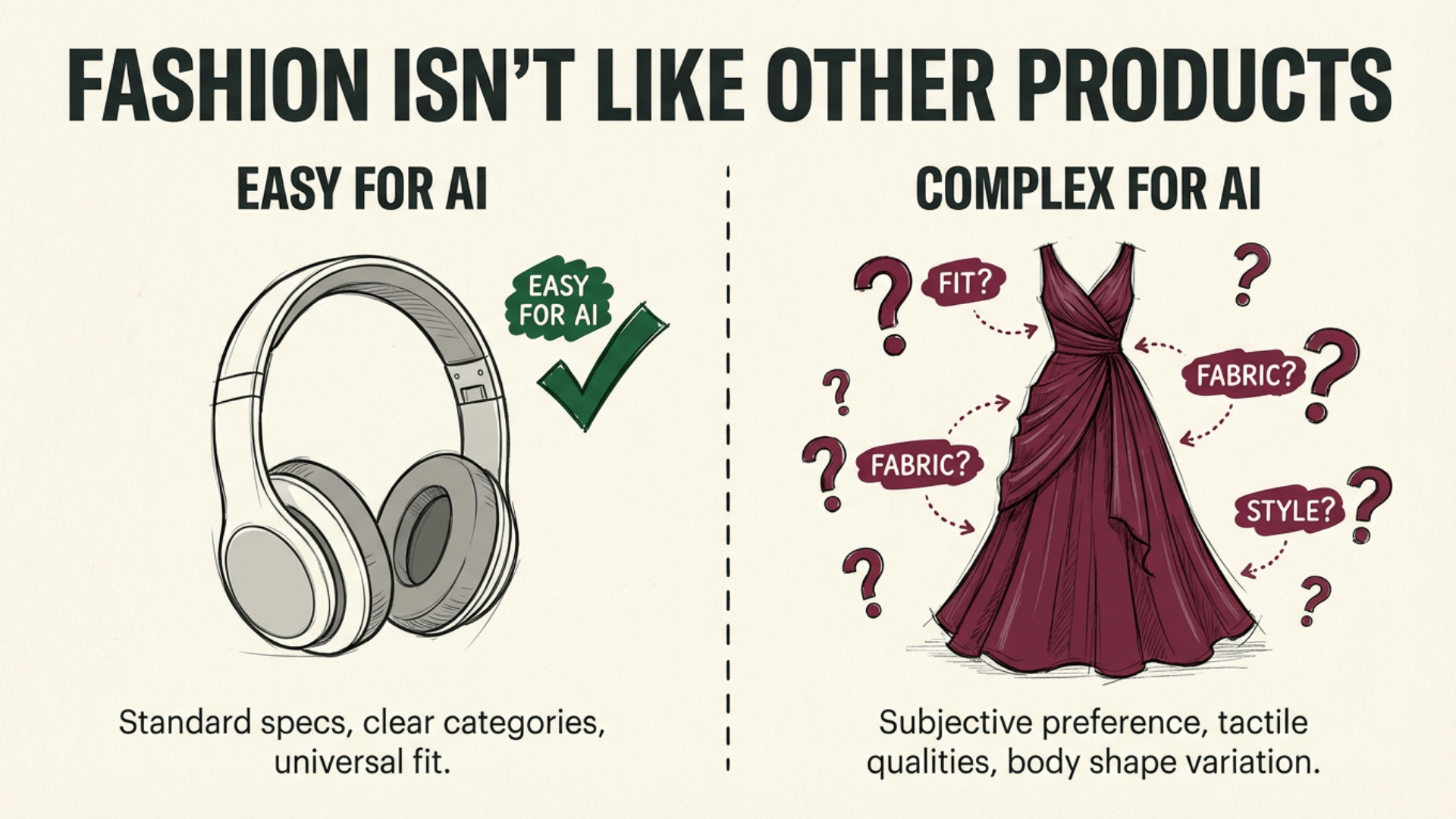
Most products are straightforward.
You need headphones? AI checks reviews, compares prices, matches features to your needs. Done.
Fashion doesn't work that way.
The fit problem: A medium in one brand is a large in another. AI needs to know your measurements AND each brand's sizing quirks.
The style problem: "Business casual" means different things in tech vs finance vs creative industries. AI needs cultural context.
The compatibility problem: That blazer looks great. But does it work with what you already own? AI needs to understand your existing wardrobe.
The occasion problem: "Cocktail attire" for a beach wedding is different from "cocktail attire" for a Manhattan fundraiser. AI needs situational awareness.
The body type problem: What looks amazing on one body type might not work for another. AI needs to understand garment construction and how it interacts with different shapes.
This is why 90% of fashion brands aren't ready for agentic commerce.
Their product data wasn't built for this level of complexity.
What AI Agents Need to Recommend Fashion
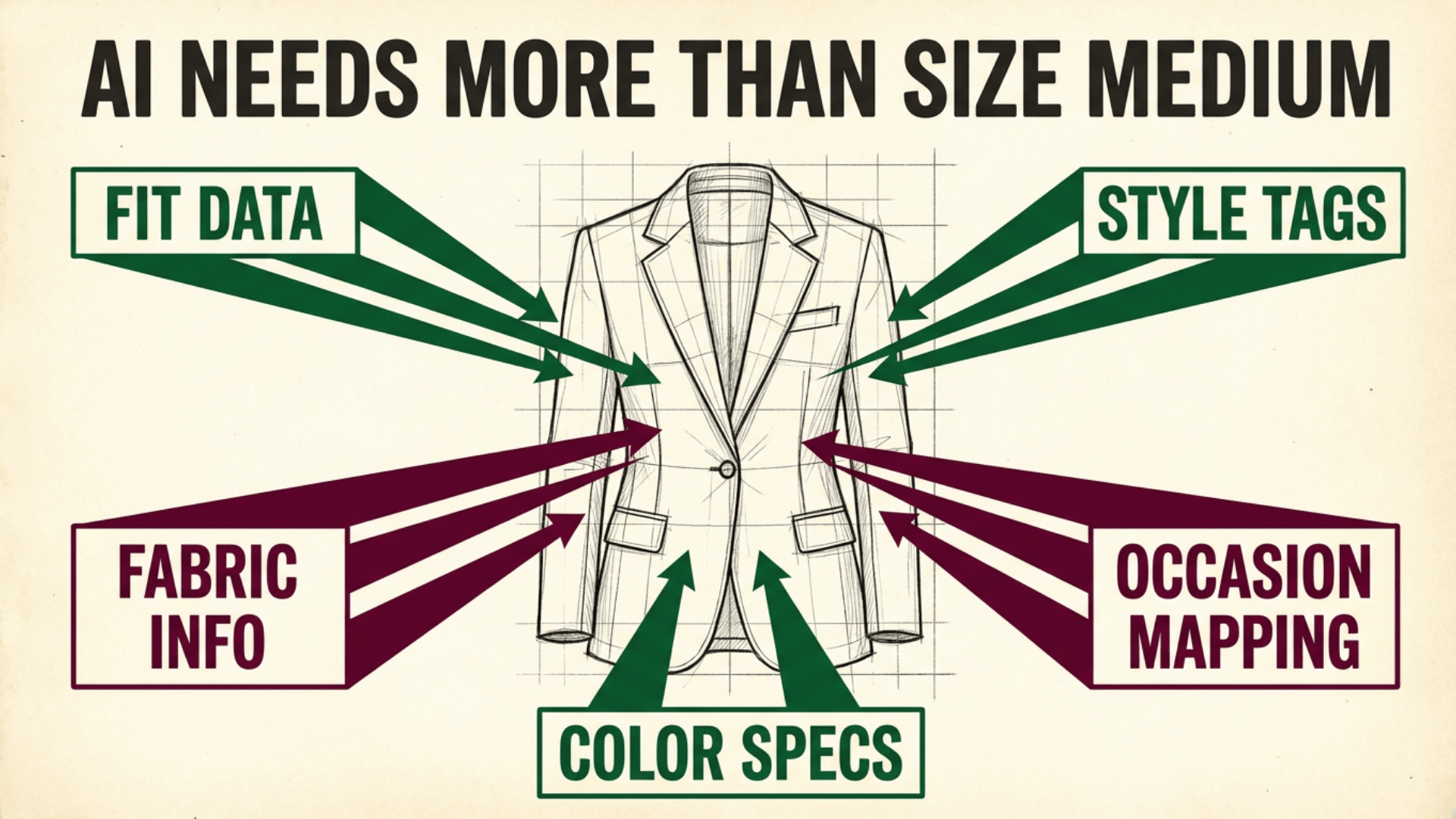
Here's what AI systems evaluate before recommending clothing.
Fit Data
AI agents need more than "Size M."
They need:
- Actual measurements (chest, waist, hip, length)
- Fit type (slim, regular, relaxed, oversized)
- Stretch percentage (how much give the fabric has)
- Rise height (for pants)
- Inseam options
- Shoulder width
- Sleeve length
Without this data, AI can't confidently recommend your product.
Most fashion brands have maybe 20% of this information in their systems.
Fabric Intelligence
"100% cotton" isn't enough.
AI agents need:
- Fabric weight (lightweight, medium, heavyweight)
- Weave type (jersey, poplin, twill, denim)
- Drape characteristics (structured vs flowing)
- Stretch properties (percentage and direction)
- Seasonality (winter weight vs summer weight)
- Care requirements (machine wash, dry clean, hand wash)
- Opacity level (sheer, semi-sheer, opaque)
This helps AI understand if the garment works for the customer's climate, lifestyle, and needs.
Style Attributes
This is where most brands completely fail.
AI needs semantic style data:
- Style category (minimalist, maximalist, classic, trendy, avant-garde)
- Formality level (casual, smart casual, business casual, business formal, black tie)
- Aesthetic tags (preppy, streetwear, bohemian, corporate, romantic)
- Trend status (timeless vs seasonal trend)
- Versatility score (works with many pieces vs statement item)
When someone asks AI for "elevated basics," the AI needs to know if your product fits that description.
Occasion Mapping
Your products need to be tagged for specific occasions:
- Work environments (tech startup, law firm, creative agency)
- Events (wedding guest, cocktail party, conference)
- Activities (travel, gym, weekend errands)
- Seasons (not just summer/winter, but early fall vs late fall)
Without this, AI agents don't know when to recommend you.
Color Intelligence
"Navy" isn't specific enough.
AI needs:
- Exact color specifications (navy with blue undertone vs navy with black undertone)
- Complementary colors (what this pairs with)
- Seasonal appropriateness
- Professional context (some industries avoid certain colors)
This helps AI build complete outfits, not just recommend single items.
The Size and Fit Challenge
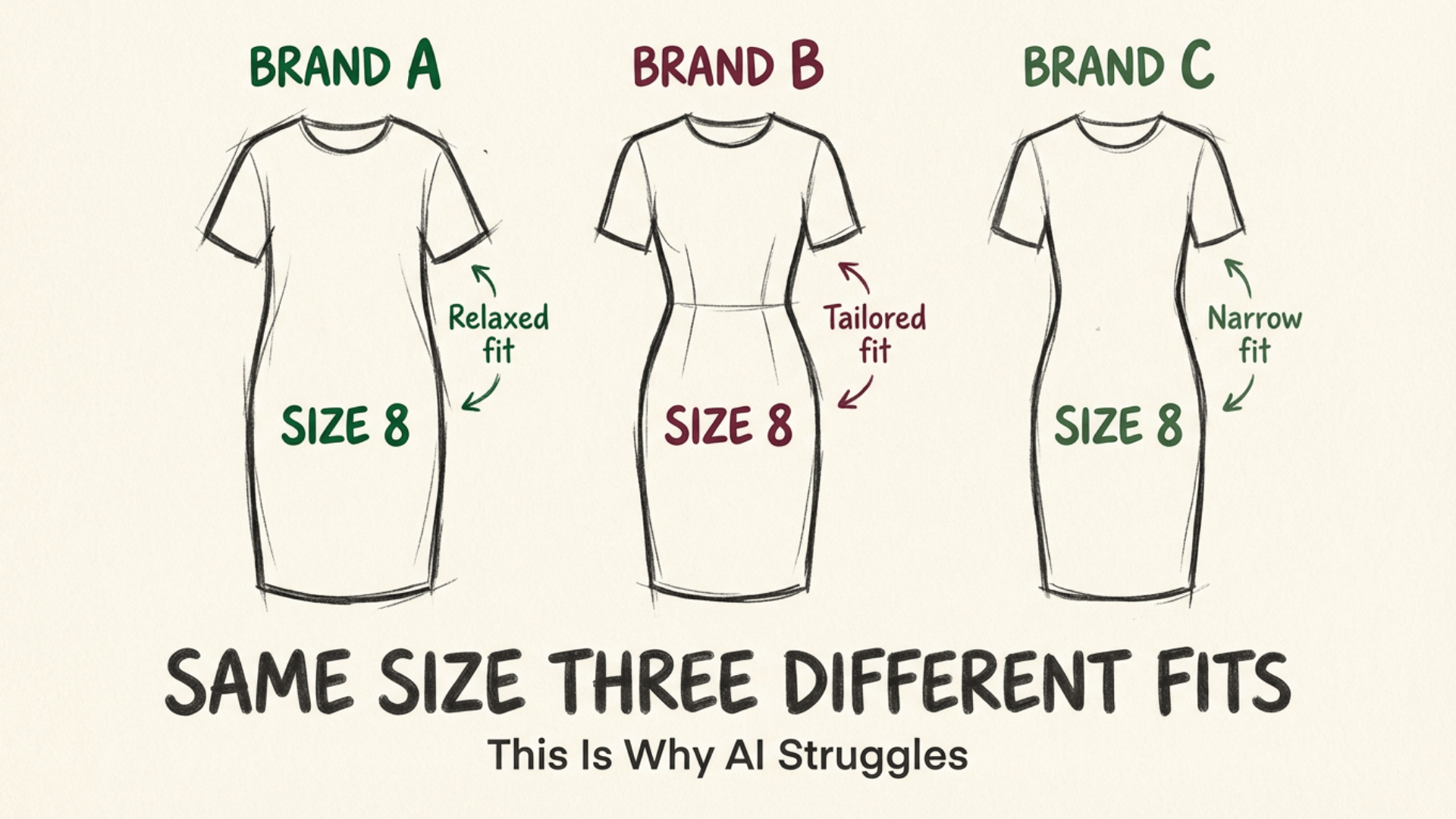
This is the biggest problem in fashion agentic commerce.
Sizing is chaos.
A size 8 dress from one brand fits like a size 10 from another brand. Italian sizing runs small. American sizing varies wildly. "One size fits most" rarely fits most.
AI agents need to navigate this nightmare.
What works:
Brands providing detailed measurement charts for every size. Not just "small, medium, large." Actual measurements in inches or centimeters.
Brands documenting their fit philosophy. "We size up for comfort." "Our cuts run slim." "Designed for petite frames."
Brands including model measurements and what size the model is wearing. This gives AI (and customers) real reference points.
What doesn't work:
Generic size charts copied from other brands. AI systems are starting to recognize when brands use template sizing data that doesn't match their actual products.
Inconsistent sizing across your own product line. If your blazers run large but your shirts run small, AI agents notice and lose confidence in recommending you.
Visual Requirements for Fashion AI
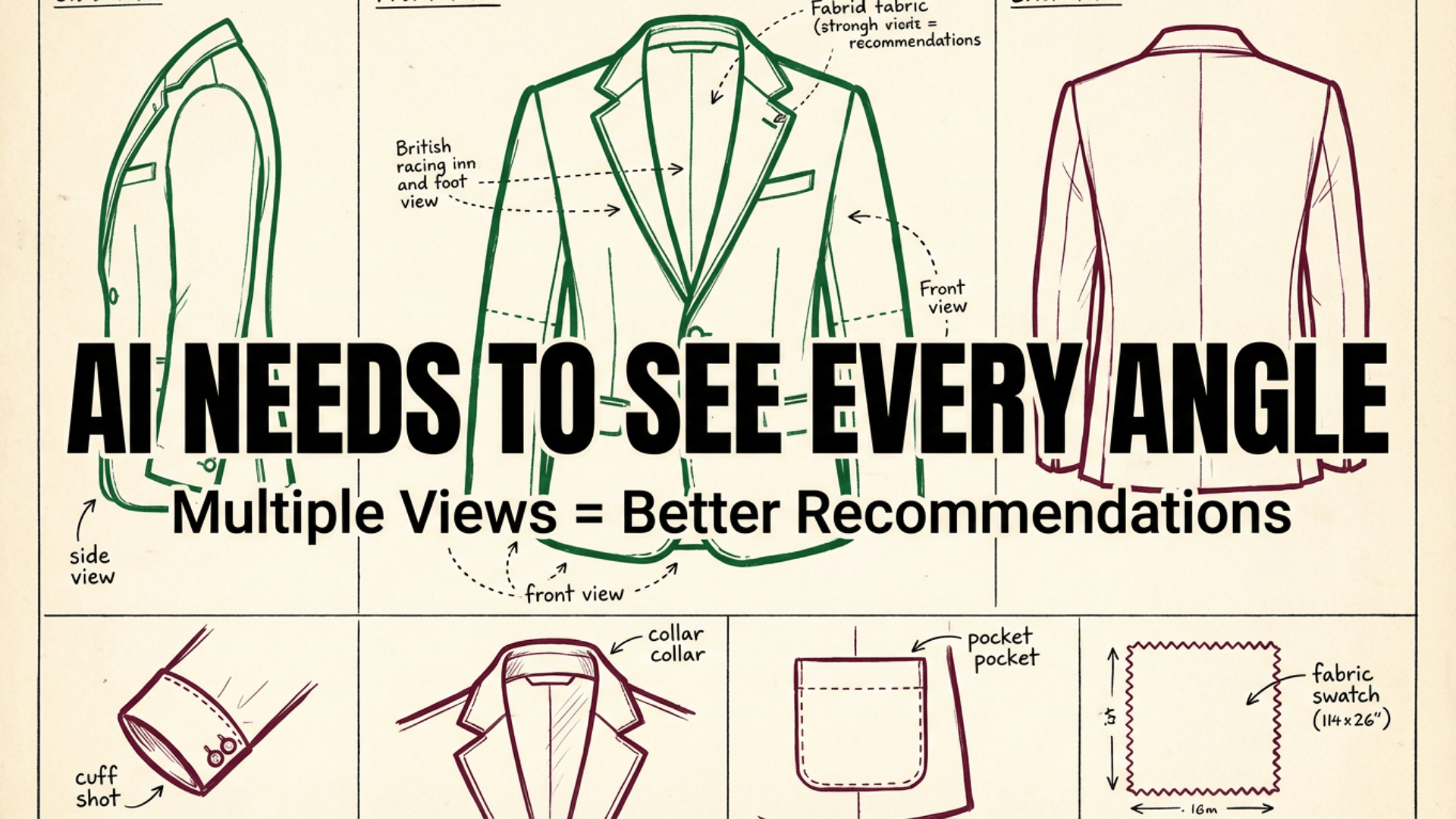
Here's something most brands miss: AI agents evaluate product imagery differently than humans.
Humans look at lifestyle shots and imagine themselves in the clothes.
AI agents need technical clarity.
What AI needs to see:
Multiple angles of the same garment. Front, back, side views minimum. Detail shots of fabric texture, closures, and construction.
Products shown on bodies, not just flat lays (unless that's your only option). AI understands drape and fit better when it sees garments worn.
Consistent lighting and backgrounds. This helps AI accurately assess color and fabric properties.
High resolution images. AI systems extract detail from images. Low-res photos limit what AI can understand about your products.
This is where Linea becomes critical.
Traditional fashion photography is expensive and slow. Shooting every product on multiple body types, in multiple angles, with consistent quality is out of reach for most brands.
Linea is Fashion NUT's creative production practice. It generates AI-optimised product imagery, campaigns and video without a traditional studio, at a fraction of the cost and turnaround of a conventional shoot.
You get the imagery AI agents need without the traditional photoshoot budget.
How AI Agents Actually Evaluate Fashion Products
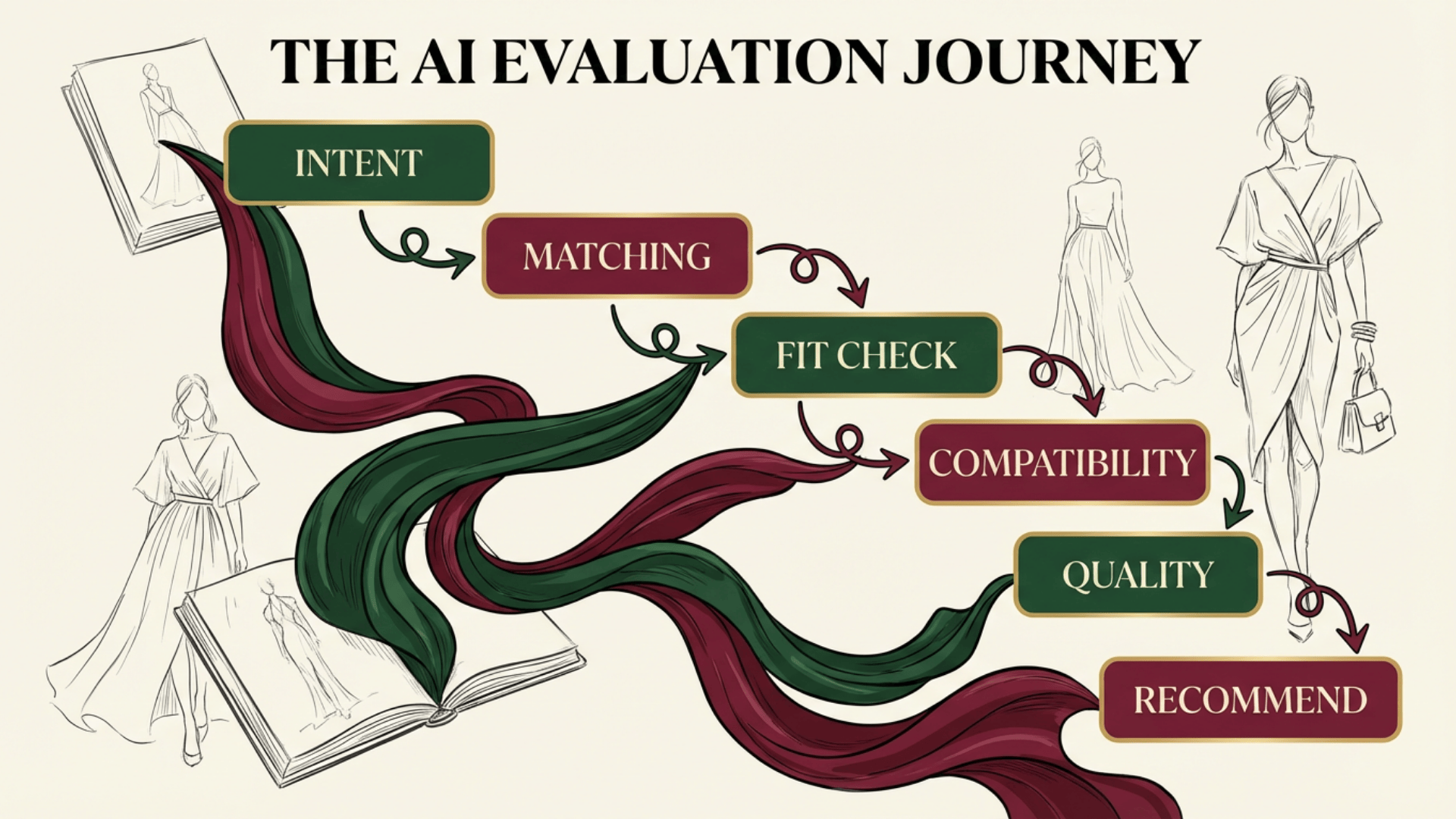
Let's walk through what happens when someone asks ChatGPT: "Find me a blazer for client meetings."
Step 1: Intent Analysis
The AI interprets "client meetings" as:
- Business professional context
- Need to project competence and polish
- Likely needs to work with dress pants or pencil skirts
- Should be versatile enough for multiple meetings
- Can't be too trendy (needs to stay appropriate for 2-3 years)
Step 2: Attribute Matching
The AI searches for products tagged with:
- Formality level: business professional
- Occasion: office, meetings, professional
- Style attributes: classic, tailored, professional
- Versatility: high
- Trend status: timeless
Your product only shows up if you've tagged it correctly.
Step 3: Fit Evaluation
The AI checks if sizing data exists. If you don't have detailed measurements, your product gets deprioritized. AI agents prefer products where they can confidently predict fit.
Step 4: Compatibility Check
If the customer has purchase history with the AI platform, it checks if your blazer works with items they already own. Color compatibility. Style coherence.
Step 5: Quality Signals
The AI evaluates trust signals:
- Brand authority (do other sources mention you?)
- Review data
- Return rate data (if available)
- Completeness of product information
Products with incomplete data get filtered out.
Step 6: Recommendation
If your product passes all filters, AI presents it to the customer with specific reasoning. "This blazer matches your professional style, works with the pants you bought last month, and fits your preference for structured tailoring."
Most fashion brands lose customers at Step 2 or Step 3 because their data isn't detailed enough.
What Fashion Brands Get Wrong
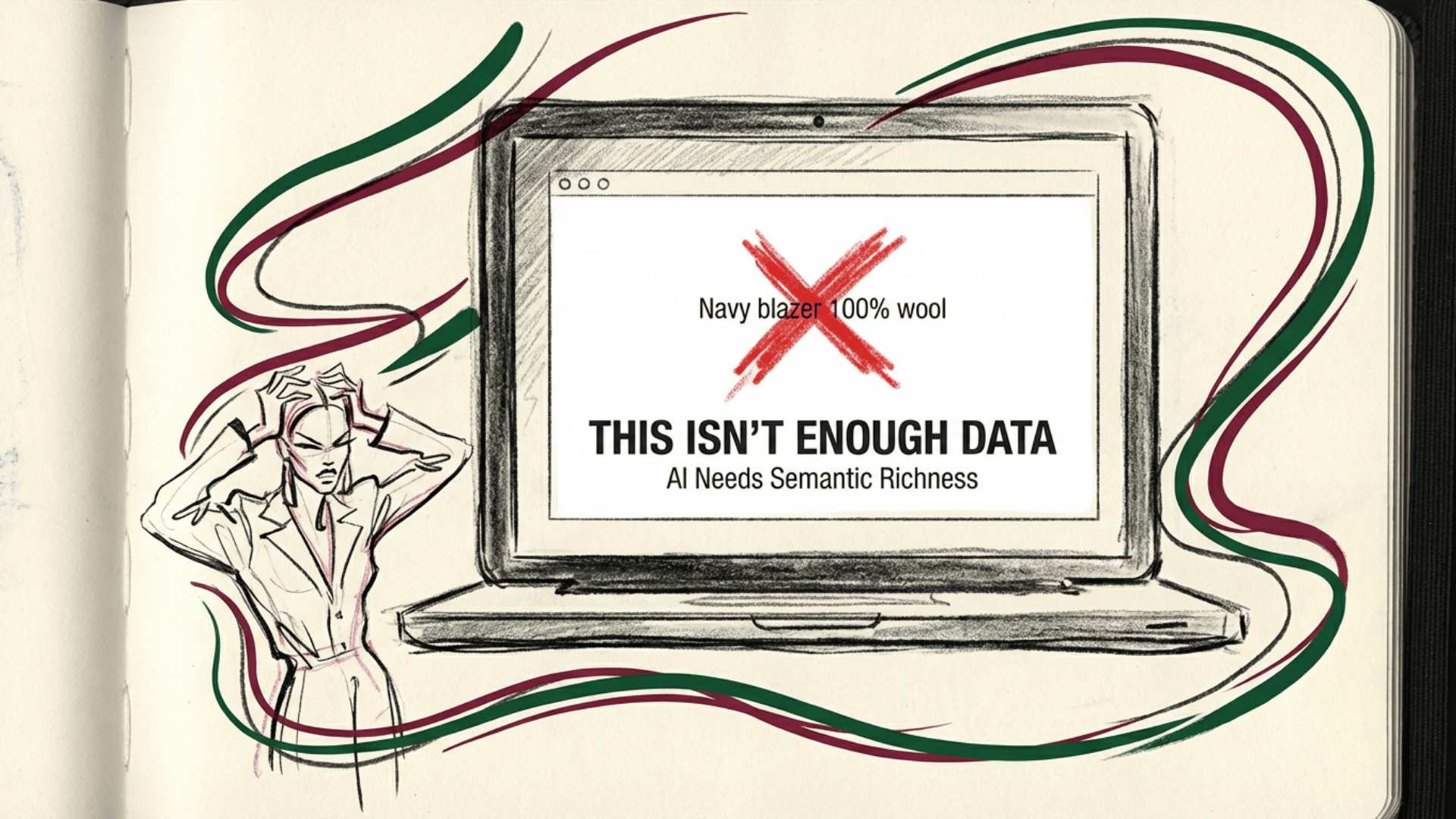
Let me show you the most common mistakes.
Mistake 1: Treating Fashion Like General E-Commerce
You can't just copy what works for electronics or home goods.
Fashion requires emotional intelligence that other categories don't need.
A laptop is a laptop. A dress is personal identity.
Mistake 2: Minimal Product Descriptions
"Classic navy blazer. 100% wool. Dry clean only."
That's not enough data for AI to work with.
AI needs semantic richness. Style context. Compatibility information. Occasion mapping.
Mistake 3: Ignoring Visual Requirements
One product photo from the front isn't sufficient.
AI agents need to see fabric texture, drape, fit from multiple angles.
Lifestyle shots are pretty but not functionally useful for AI evaluation.
Mistake 4: Inconsistent Data Across Products
Your dresses have detailed descriptions. Your pants have minimal information. Your accessories are barely tagged.
AI agents notice inconsistency and trust you less.
Mistake 5: No Brand Positioning
AI needs to know what you stand for.
Are you sustainable? Luxury? Affordable basics? Trend-forward? Classic?
Without clear positioning, AI doesn't know when to recommend you.
Prompt Commerce for Fashion: The Solution

This is why Fashion NUT developed Prompt Commerce specifically for fashion brands.
It's not general agentic commerce strategy adapted for fashion.
It's built from the ground up for apparel complexity.
The Three Pillars Applied to Fashion
Pillar 1: Semantic Product Intelligence for Fashion
Enriching every product with:
- Detailed fit and measurement data
- Fabric properties and characteristics
- Style attributes and aesthetic tags
- Occasion and versatility mapping
- Color intelligence and pairing suggestions
- Body type suitability information
This gives AI agents the data they need to confidently recommend your products.
Pillar 2: Conversational Brand Positioning for Fashion
Defining your brand so AI understands:
- Your style philosophy (minimalist, maximalist, classic, avant-garde)
- Your ideal customer profile (not demographics, actual style characteristics)
- Your price-quality positioning
- Your values (sustainability, inclusivity, craftsmanship)
- Who you're for and who you're NOT for
When someone asks AI for "sustainable workwear," AI knows if you're the answer.
Pillar 3: Intent-Driven Content for Fashion
Creating content that answers real questions customers ask AI:
- "What should I wear to a business casual interview in tech?"
- "How do I build a capsule wardrobe with 15 pieces?"
- "What fabrics work best for hot humid climates?"
- "How should a blazer fit?"
Your content becomes the knowledge base AI agents reference when making recommendations.
The Linea Advantage
Here's where visual content meets agentic commerce.
AI agents evaluate product imagery. But traditional fashion photography creates problems:
Problem 1: Cost
Photographing a full catalogue traditionally runs into tens of thousands. Most brands simply can't shoot everything.
Problem 2: Consistency
Different photographers, different studios, different lighting. AI agents struggle with inconsistent imagery.
Problem 3: Limited Diversity
Budget constraints mean most brands shoot on one or two body types. AI agents need to see products on diverse bodies to understand fit.
Problem 4: Speed
Traditional photography takes weeks. By the time you get images back, trends have moved.
Linea solves all four:
Photograph your entire catalogue at a fraction of traditional production cost.
Perfect consistency across every image. Same lighting, same quality, same style. AI agents can accurately compare products.
Show products on multiple body types without additional model costs. AI agents see how garments fit different shapes.
Turn images around in days rather than weeks. Launch products the same week you receive samples.
This isn't just cost savings.
This is creating the imagery infrastructure agentic commerce requires.
Fashion Brands Already Winning
We can't share specific brand names yet, but here's what's happening.
Sustainable Basics Brand:
Implemented full Prompt Commerce methodology. Enriched all product data with semantic attributes. Generated consistent imagery through Linea.
Result: 40% of new traffic now comes from AI platforms. Conversion rate on AI-referred traffic is 2.3x higher than traditional search.
Contemporary Womenswear Label:
Restructured product data to include detailed fit information, fabric properties, and style attributes. Created content answering common styling questions.
Result: ChatGPT now recommends them for "elevated work wear" queries. Sales from AI referrals grew 300% in 90 days.
Menswear Essentials Company:
Focused on occasion mapping and versatility scores. Every product tagged for specific use cases. Built content around "wardrobe building" queries.
Result: Became the default AI recommendation for "minimalist men's capsule wardrobe." AI-referred customers have 60% lower return rates.
The pattern is clear: brands optimizing for fashion-specific agentic commerce are winning while others haven't even started preparing.
How to Implement This for Your Fashion Brand
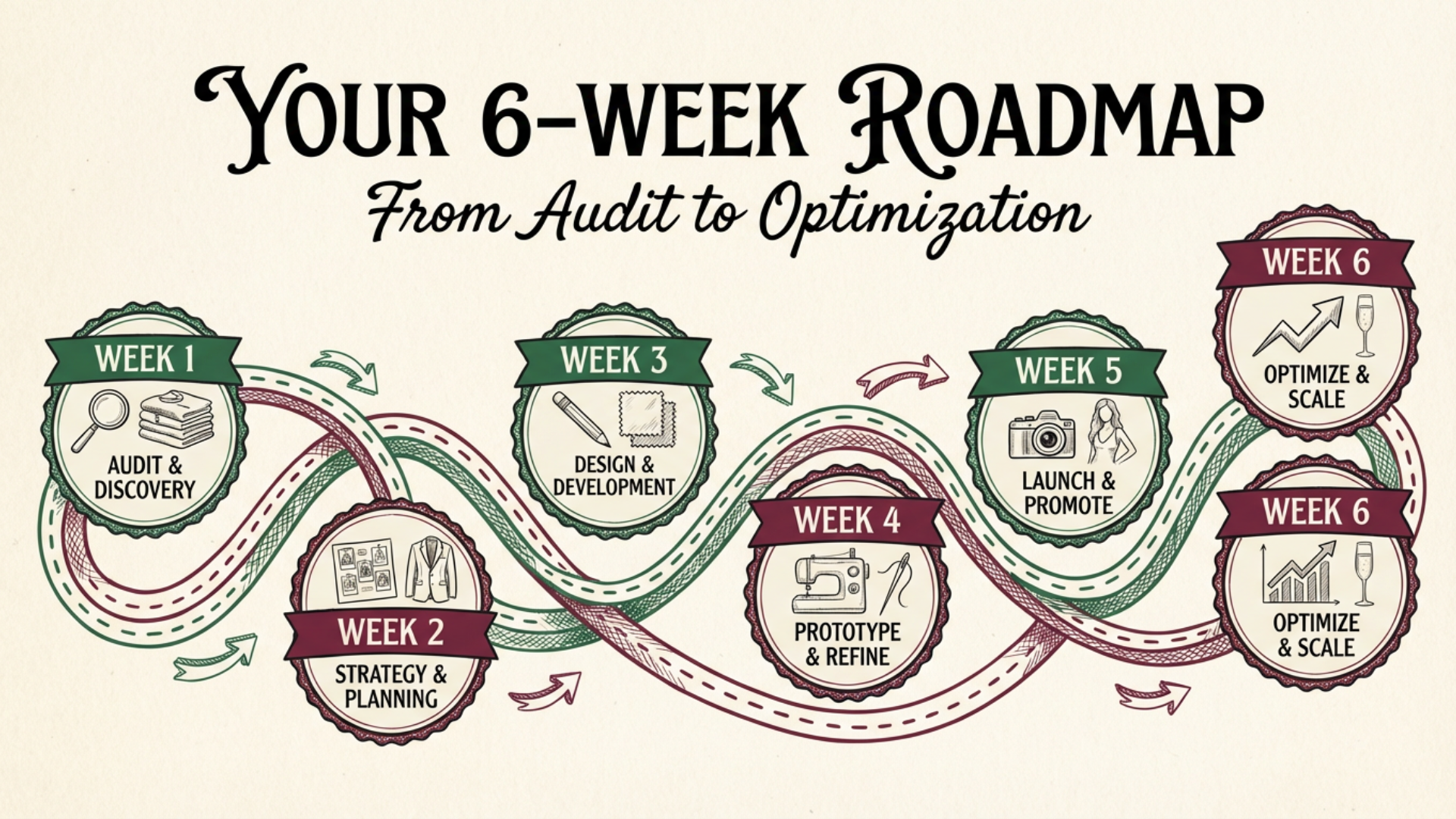
Let's make this practical.
Phase 1: Product Data Audit (Week 1)
Review your current product data against AI requirements.
For each product, check if you have:
- Detailed measurements (not just S/M/L)
- Fabric specifications beyond basic composition
- Style attribute tags
- Occasion mapping
- Versatility information
- Color pairing suggestions
Most brands find they have 20-30% of what AI agents need.
Phase 2: Semantic Enrichment (Week 2-3)
Start adding missing data systematically.
Begin with your bestsellers and new arrivals. These matter most for AI recommendations.
Add:
- Exact measurements for every size
- Detailed fabric properties
- Style tags (minimum 5 per product)
- Occasion tags (minimum 3 per product)
- Compatibility information
This is labor-intensive. But it's the foundation of everything else.
Phase 3: Visual Content Upgrade (Week 3-4)
Evaluate your product imagery against AI requirements.
Do you have multiple angles? Consistent quality? Products shown on bodies?
For gaps, use Linea to generate the missing imagery. Start with high-priority products.
Phase 4: Brand Positioning (Week 4)
Document your brand positioning for AI systems.
Write clear statements about:
- Your style philosophy
- Your ideal customer (actual characteristics, not demographics)
- Your values and differentiators
- Who you serve and who you don't
Make this information accessible on your site in structured format.
Phase 5: Content Strategy (Week 5-8)
Map the questions your customers ask AI agents about fashion.
Create comprehensive answers. Not 300-word blog posts. Definitive resources.
Topics to cover:
- Styling advice for specific occasions
- Fit guidance for your product categories
- Fabric education
- Wardrobe building strategies
- Care and maintenance
This content becomes what AI agents reference when recommending you.
Phase 6: Measurement and Iteration (Ongoing)
Track AI-referred traffic in your analytics.
Test target queries weekly in ChatGPT, Perplexity, and Claude.
Document when you appear and when you don't.
Optimize based on gaps.
The Specific Challenges Fashion Categories Face
Different fashion categories have unique AI challenges.
Womenswear
The hardest category for AI agents.
Sizing inconsistency is extreme. Fit preferences vary dramatically. Style is highly personal.
Success requires: Exceptionally detailed fit data. Multiple body type representation. Clear style positioning.
Menswear
More standardized than womenswear but still complex.
Challenge: Men often don't know how things should fit. AI needs to educate while recommending.
Success requires: Fit education content. Versatility emphasis. Classic style positioning works well.
Luxury Fashion
AI agents need to understand why a product commands premium pricing.
Challenge: Justifying price through data AI can understand.
Success requires: Detailed craftsmanship information. Heritage storytelling. Quality indicators AI recognizes.
Sustainable Fashion
AI agents are starting to evaluate sustainability claims critically.
Challenge: Vague "eco-friendly" claims don't cut it anymore.
Success requires: Specific certifications. Transparent supply chain data. Measurable impact metrics.
Plus-Size Fashion
AI agents need to recommend based on body type, not just size number.
Challenge: Generic "plus size" category doesn't account for body shape diversity.
Success requires: Detailed fit information for different body shapes. Real body type representation in imagery.
Common Questions Fashion Brands Ask
Do we need to rebuild our entire website?
No.
Your website can stay exactly as it is for human visitors.
Prompt Commerce is about adding structured data and information AI agents can access. This doesn't require redesigning your site.
You're adding a layer, not replacing what exists.
What if our brand is too small for AI to know about?
Brand size matters less than data quality.
AI agents discover products through structured data, not brand fame.
A small brand with excellent product data gets recommended over a famous brand with poor data.
How long until this affects our sales?
It's already affecting them.
A meaningful share of your potential customers are using AI for shopping research right now, and that share is growing quickly.
Brands optimizing now capture this growing segment. Brands waiting lose these customers to competitors.
Can we just hire an agency to do this?
Most agencies don't understand fashion-specific optimization yet.
They'll apply general e-commerce strategies that miss fashion's unique requirements.
You need fashion-specific expertise. That's what Fashion NUT provides.
What about our existing SEO strategy?
Agentic commerce doesn't replace SEO. It's additive.
Keep your SEO efforts running. Add agentic optimization on top.
Think of it as preparing for the next platform while maintaining your current ones.
How much does implementation cost?
It depends on catalogue size and how much of the work you keep in house.
Product data enrichment is mostly internal labour. Budget 20 to 40 hours per 100 products.
Visual content and content production scale with volume. We scope both on a call rather than quoting blind.
Tell us what you're building and we'll give you a real number.
What Happens If You Wait
Let's be direct about this.
Agentic commerce for fashion isn't optional.
It's not a trend you can sit out.
Every major technology and retail company is building this infrastructure right now. Google's Universal Commerce Protocol is live. OpenAI's Agentic Commerce Protocol is live. Shopify integration is live.
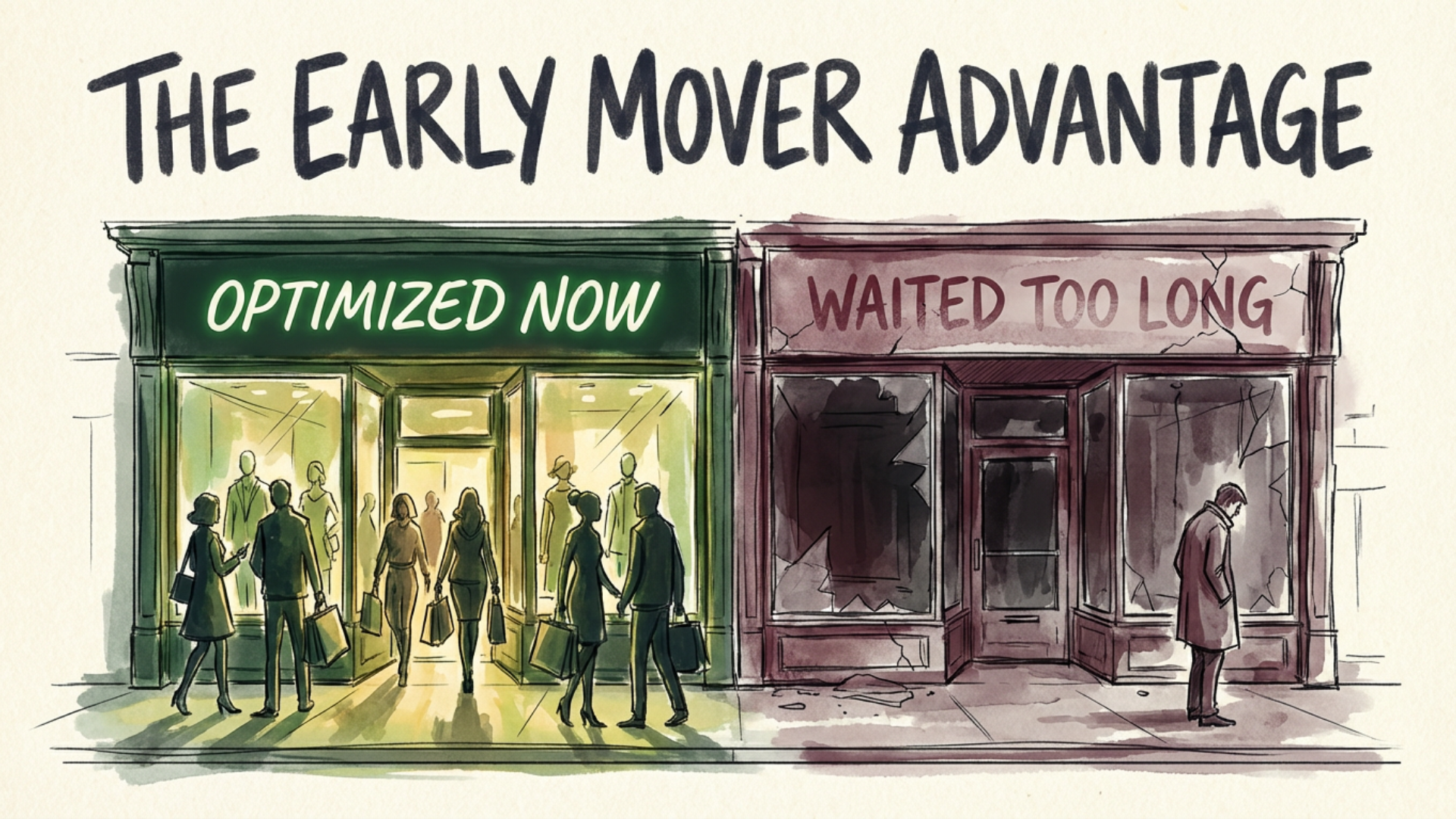
The brands optimizing now are establishing authority that compounds.
When AI systems start recommending your brand, they continue recommending you more often. Success builds on itself.
The brands waiting are falling behind in ways they can't easily reverse.
AI agents develop "preferences" based on which brands consistently provide good data and positive customer outcomes. Once competitors establish themselves as reliable recommendations, displacing them becomes difficult.
By the time everyone realizes this is the primary way people shop, the winning brands will already be established.
The Fashion NUT Approach
Fashion NUT is a Fashion Intelligence Lab. We work exclusively with fashion and lifestyle brands.
Not general e-commerce. Not all retail categories. Fashion specifically.
What we provide:
Origin, a 45-day brand launch system for founders building a fashion or lifestyle brand from strategy through to launch.
Linea, creative production covering product imagery, campaigns, video and digital brand models, built to meet what AI agents need to evaluate your products.
Prompt Commerce, the methodology for making your brand discoverable and recommendable inside AI conversations. Product data enrichment, brand positioning and content strategy.
Academy, practical AI workshops for fashion teams, leadership and fashion schools.
Who we work with:
Fashion brands across the US, UK, Europe and Asia. Menswear, womenswear, lingerie, luxury, beauty. Independent labels to established houses.
Brands serious about capturing AI-driven shopping. Not brands looking for quick fixes or magic solutions.
Brands ready to invest in their AI-discoverability infrastructure the same way they invested in SEO a decade ago.
The Bottom Line
Agentic commerce for fashion is fundamentally different from general agentic commerce.
Fashion's complexity around fit, style, occasion, and personal identity requires specialized approaches.
Generic optimization strategies fail because they don't account for what makes fashion unique.
Fashion brands need:
- Semantic product data enrichment
- AI-optimized visual content
- Fashion-specific brand positioning
- Intent-driven content strategy
This is what Prompt Commerce delivers.
The brands implementing this now are the brands AI agents will recommend for the next decade.
The brands waiting are losing customers to competitors they might not even know about yet.
The infrastructure is live. The customer behavior is changing. The opportunity is now.
Talk to Fashion NUT about your brand's AI visibility →
About Fashion NUT
Fashion NUT is a Fashion Intelligence Lab helping fashion and lifestyle brands build, launch and grow in the AI era. Founded by Tam Sood, it offers Origin for brand launches, Linea for creative production, Prompt Commerce for AI discoverability, and Academy for AI capability building.