
TL;DR: Traditional fashion photoshoots cost $15,000-$50,000 and take 6-8 weeks. DIY AI tools are cheap but produce inconsistent results that damage brand perception. Professional AI photography services deliver the speed and scale benefits while maintaining the quality standards your brand requires. Most fashion brands in 2026 are adopting a hybrid approach—but the gap between amateur AI outputs and professional-grade AI photography is widening.
Fashion brands face an impossible math problem.
You need hundreds of product images per season. Professional photography runs $15,000-$50,000 per shoot. And by the time you get your final images, the trend has already peaked.
AI fashion photography promises to fix this.
But here's what nobody tells you: there's a massive quality gap in the AI photography market.
On one end, you have cheap DIY tools promising studio-quality results. On the other, professional AI photography services that actually deliver them.
The difference matters more than you think.
The Three-Tier Reality of Fashion Photography in 2026
The market has split into three distinct categories. Understanding where each fits determines whether AI photography elevates your brand or damages it.
Tier 1: Traditional Fashion Photoshoots
The gold standard for editorial and hero content. Expensive, slow, but unmatched for emotional storytelling.
Tier 2: DIY AI Photography Tools
Cheap subscription platforms promising anyone can create professional imagery. Results vary wildly. No creative direction. No quality control. Your brand becomes the guinea pig.
Tier 3: Professional AI Photography Services
The strategic middle ground. Combines AI efficiency with professional creative expertise. Delivers speed and scale without sacrificing the quality your brand demands.
Most brands make the mistake of comparing only Tier 1 and Tier 2—then wonder why their AI experiment failed.
Traditional Photoshoot Costs: The Full Picture
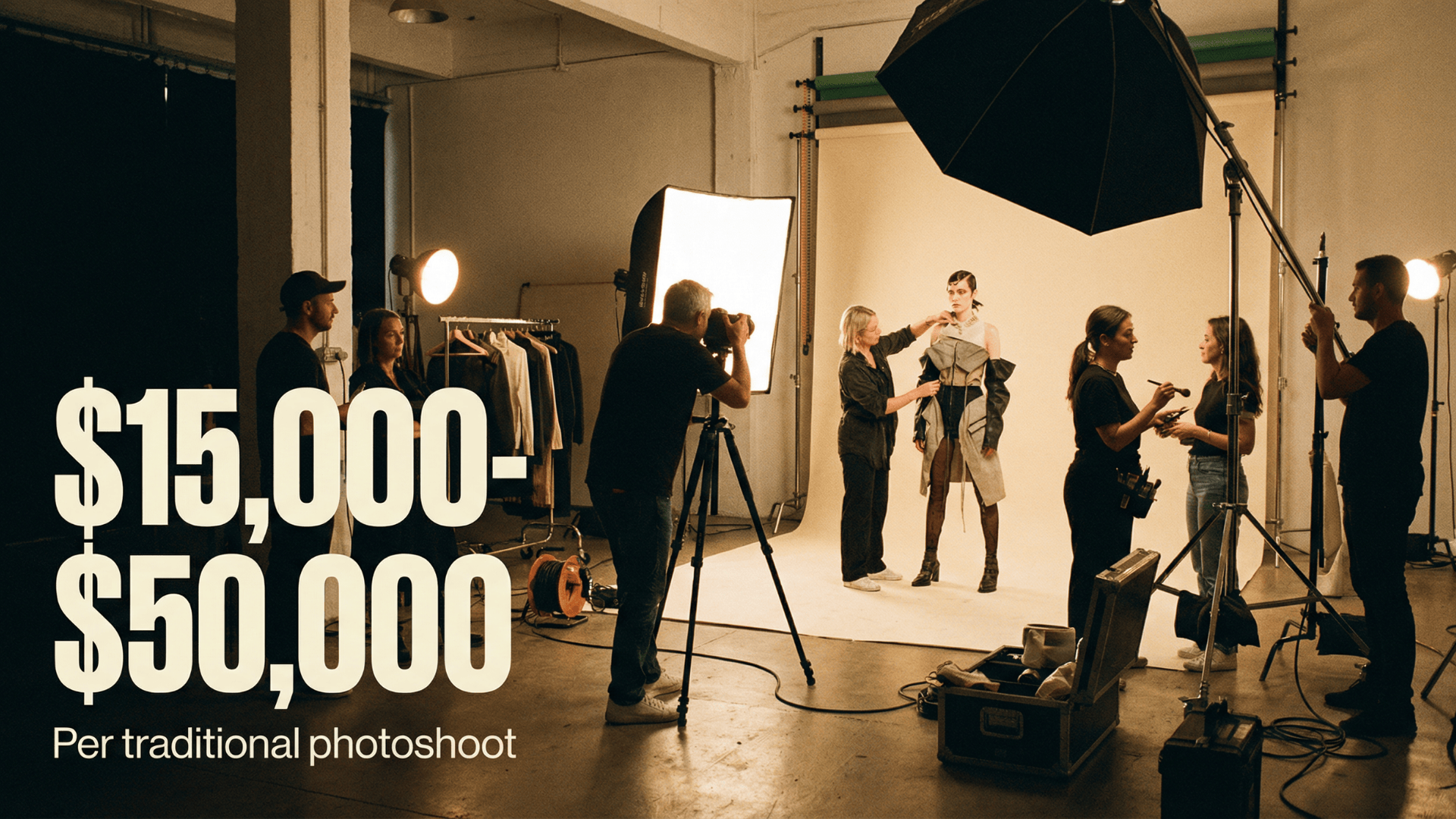
Let's start with what you're actually paying for traditional photography.
A single fashion photoshoot involves more line items than most brands realise.
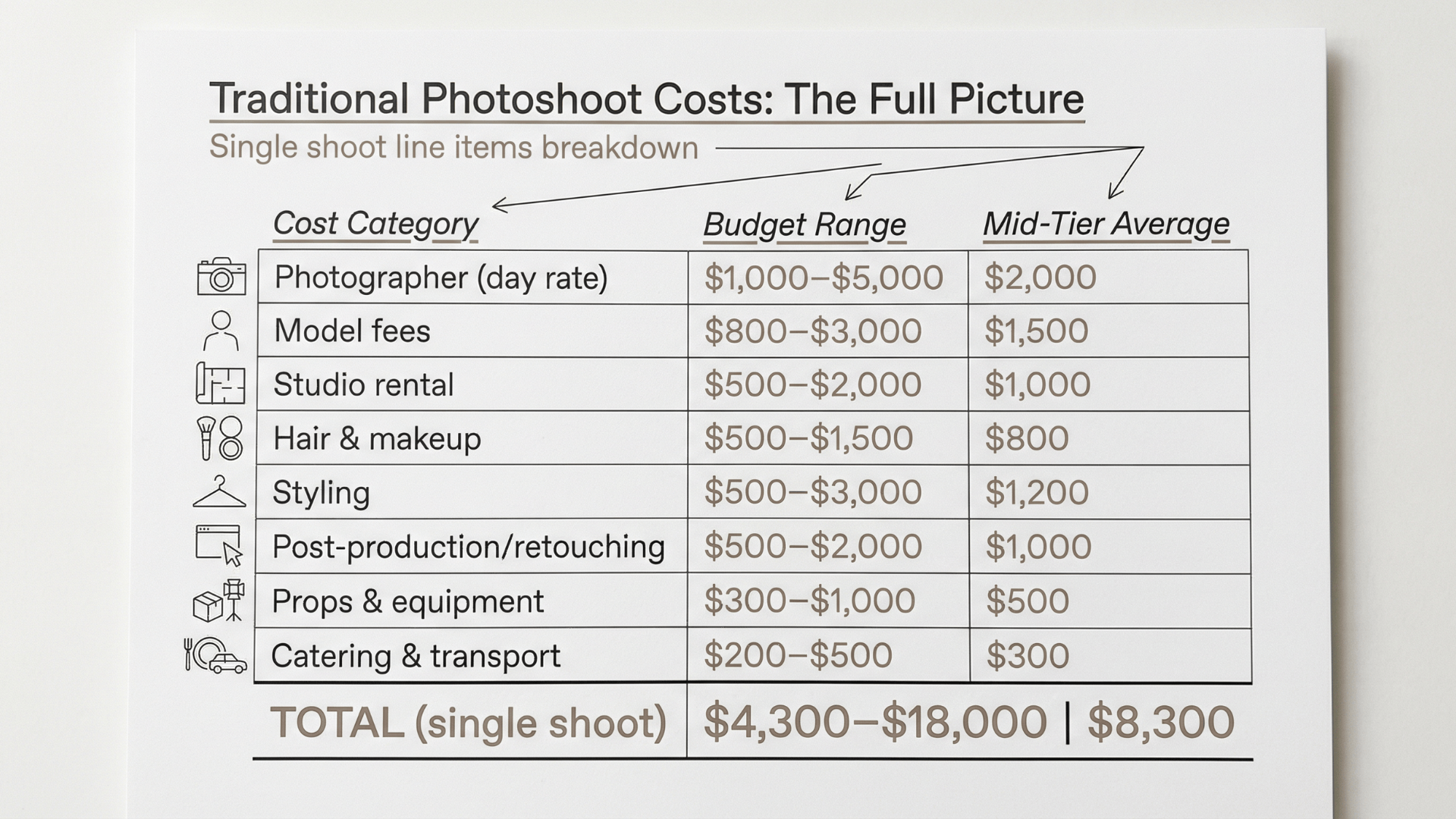
But that's just the visible costs.
Hidden expenses add 30-50% more. Reshoots due to lighting issues or model availability run $1,500-$3,000 each. Sample shipping and coordination add $500-$1,000 per shoot.
Usage rights are the silent killer. Licensing fees for commercial use often add 30-50% to the total shoot cost. Expanding from local to international markets increases costs further.
For a brand with 50 SKUs per season, comprehensive product coverage requires $15,000-$50,000 annually in photography alone.
McKinsey found that time-to-market delays cost fashion brands 15-25% in potential revenue for trend-driven products.
The maths doesn't work for most growing brands.
The DIY AI Tool Trap
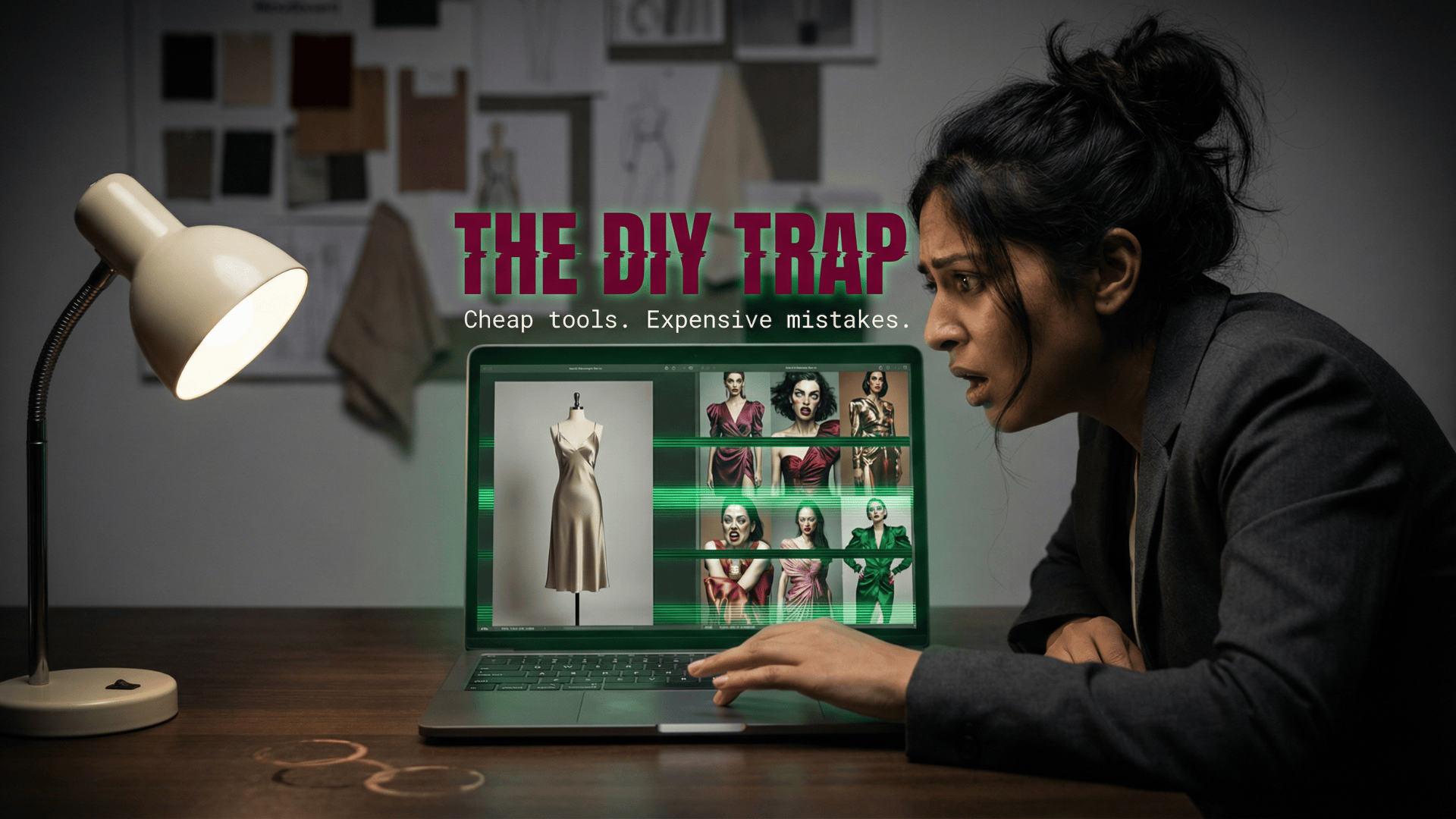
This is where most brands go wrong.
They see the traditional photography costs. They discover cheap AI tools promising "studio-quality results in seconds." They think they've found the solution.
Six months later, their product pages look inconsistent. Conversion rates have dropped. The "savings" evaporated into lost sales.
What DIY AI Tools Actually Deliver
Inconsistent quality across your catalogue. One image looks acceptable. The next looks obviously artificial. Your brand aesthetic fragments across hundreds of SKUs.
No creative direction. These tools generate images. They don't understand your brand positioning, your target customer, or your visual identity. You get generic outputs that could belong to any brand.
Technical skill requirements nobody mentions. Prompt engineering, input image preparation, output selection, post-processing—DIY tools shift the work to you. Most brands lack the expertise to get consistent results.
The uncanny valley problem. Skin tones that feel wrong. Fabric drape that doesn't convince. Hands and poses that trigger immediate distrust. Your customers notice, even if they can't articulate why.
No quality control. You become the quality assurance department. Every image requires manual review. The "time savings" disappear into endless iteration.
J.Crew learned this publicly. When a campaign was revealed to be AI-generated, fans noticed the inconsistencies immediately—jawlines that shifted between shots, patterns that fuzzed into static, proportions that didn't hold.
The backlash wasn't about AI. It was about quality.
The Hidden Cost of Cheap AI
Baymard Institute research indicates that inconsistent product imagery reduces conversion rates by 18-26%.
If your catalogue generates $500,000 annually, a 20% conversion drop costs you $100,000.
That cheap subscription "savings" just became the most expensive mistake you made this year.
Professional AI Photography Services: The Strategic Advantage
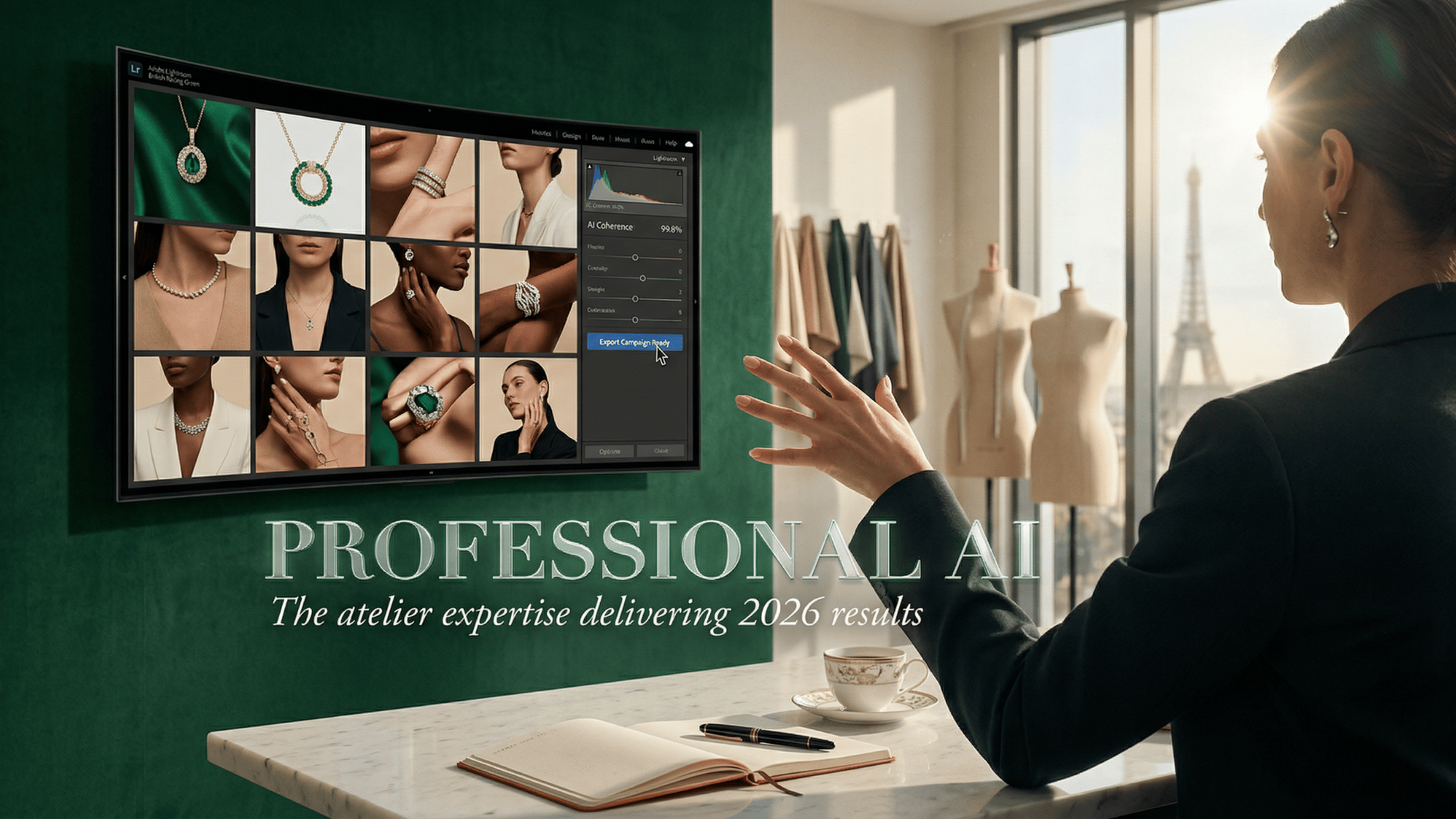
Professional AI photography services exist because the DIY approach fails most brands.
The difference isn't the underlying technology. It's the expertise layer built on top.
What Professional AI Photography Delivers
Consistent brand aesthetic across your entire catalogue. Every image reflects your visual identity. Your product pages look cohesive. Your brand perception stays intact.
Creative direction built in. Professional services understand fashion. They know how to position products, select appropriate model representations, and create imagery that converts.
Quality control you don't have to manage. Outputs are reviewed and refined before delivery. You receive production-ready imagery, not raw AI outputs requiring hours of your time.
Technical expertise without the learning curve. Input preparation, generation parameters, post-processing—handled by specialists who've optimised the process across thousands of images.
Speed and scale without quality sacrifice. The efficiency benefits of AI with the quality standards of professional photography.
The Results Gap
Boston Consulting Group's 2024 report found that fashion brands adopting professional AI photography solutions reduced visual content costs by an average of 87% while increasing production volume by 4x.
Note the distinction: professional solutions, not DIY tools.
Shopify's 2024 Commerce Report showed that merchants using professional AI photography experienced 34% higher conversion rates compared to those using DIY methods.
Vue.ai reports that clients using professional AI imagery services see conversion rates increase by up to 60%.
Label Emmaüs, a second-hand fashion marketplace, saw conversion rates jump 56% after implementing professional AI photography—not after subscribing to a cheap DIY tool.
The technology is the same. The results are not.
Timeline Comparison: The Real Numbers
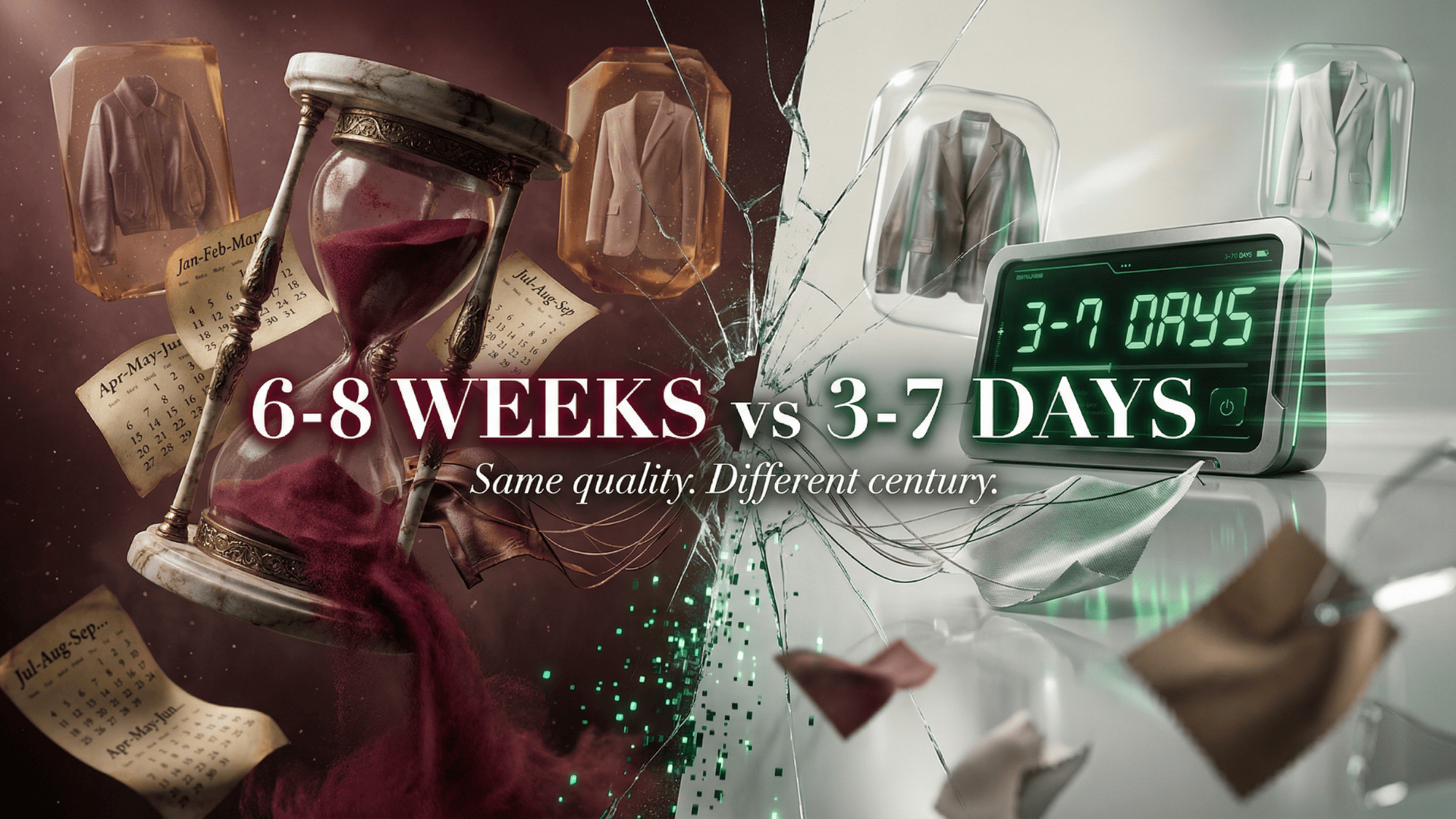
Speed is where AI photography delivers undeniable advantage.
But the timeline gap between DIY and professional services matters more than most brands realise.
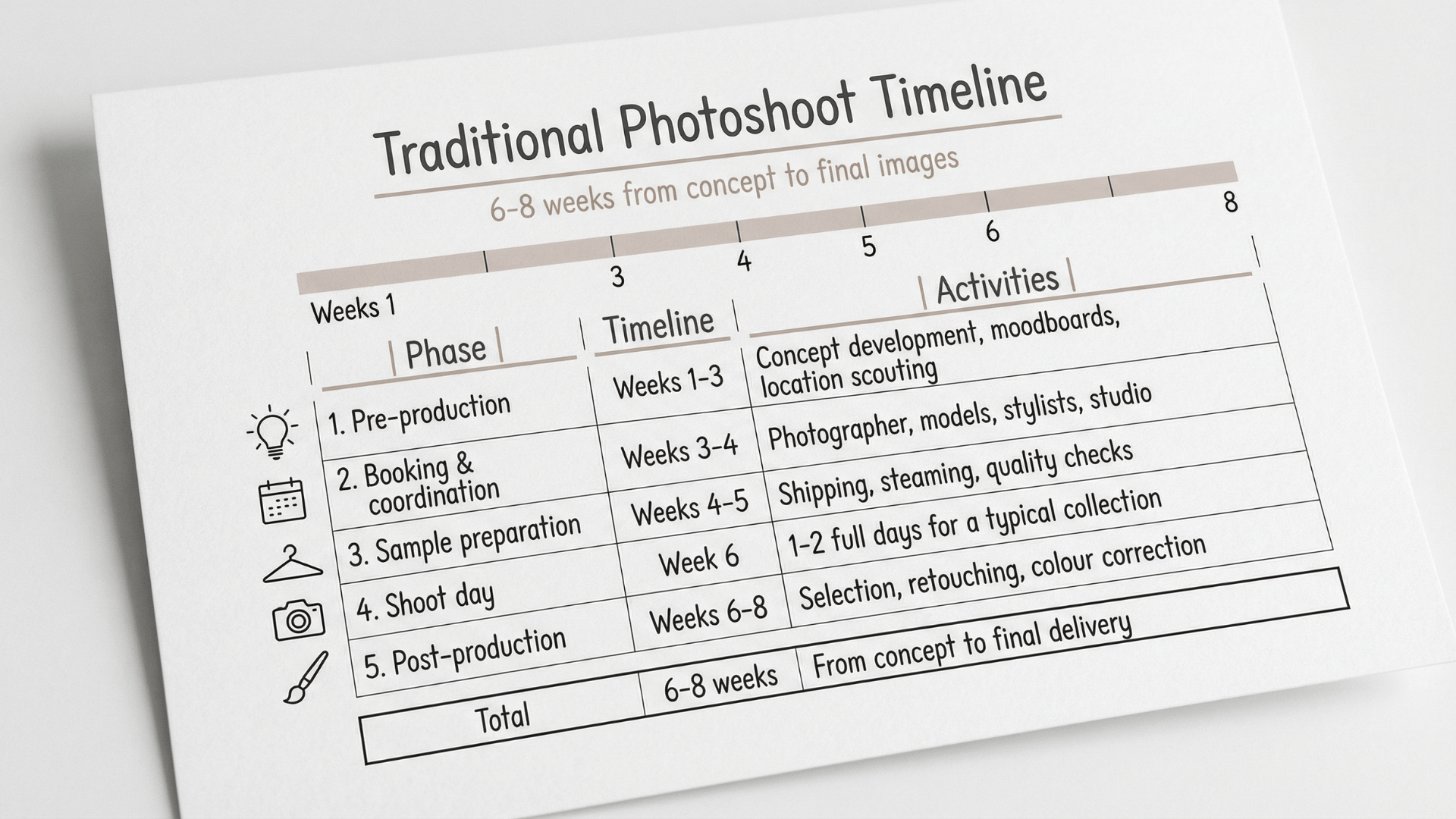
Traditional Photoshoot Timeline
A well-planned fashion shoot requires 6-8 weeks from concept to final images.
DIY AI Tool Timeline (The Reality)
The marketing promises "seconds." The reality is different.
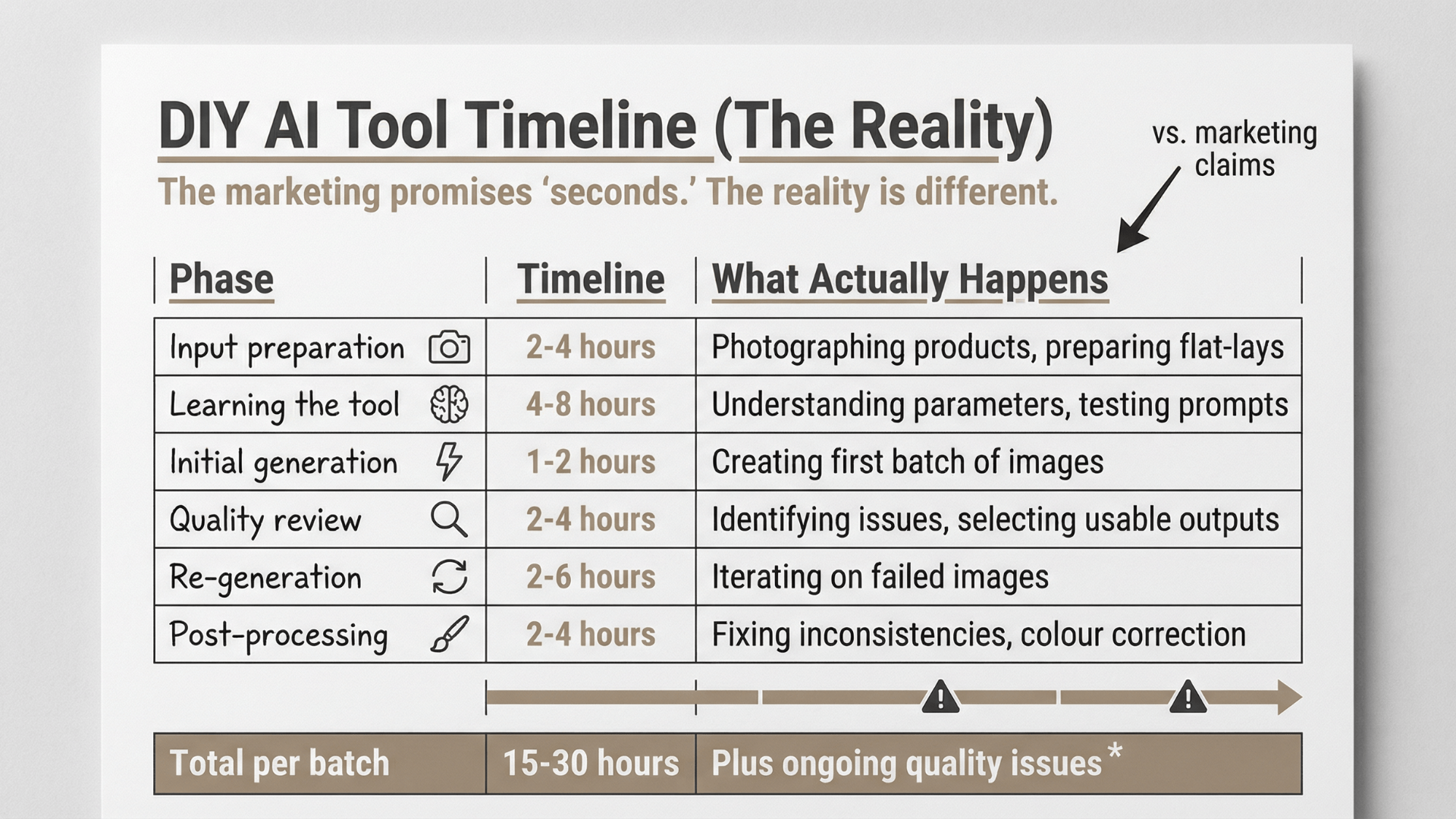
Multiply across your full catalogue. Factor in the learning curve. Account for the images that never reach acceptable quality.
The "instant" solution often takes longer than expected—and delivers worse results.
Professional AI Photography Timeline
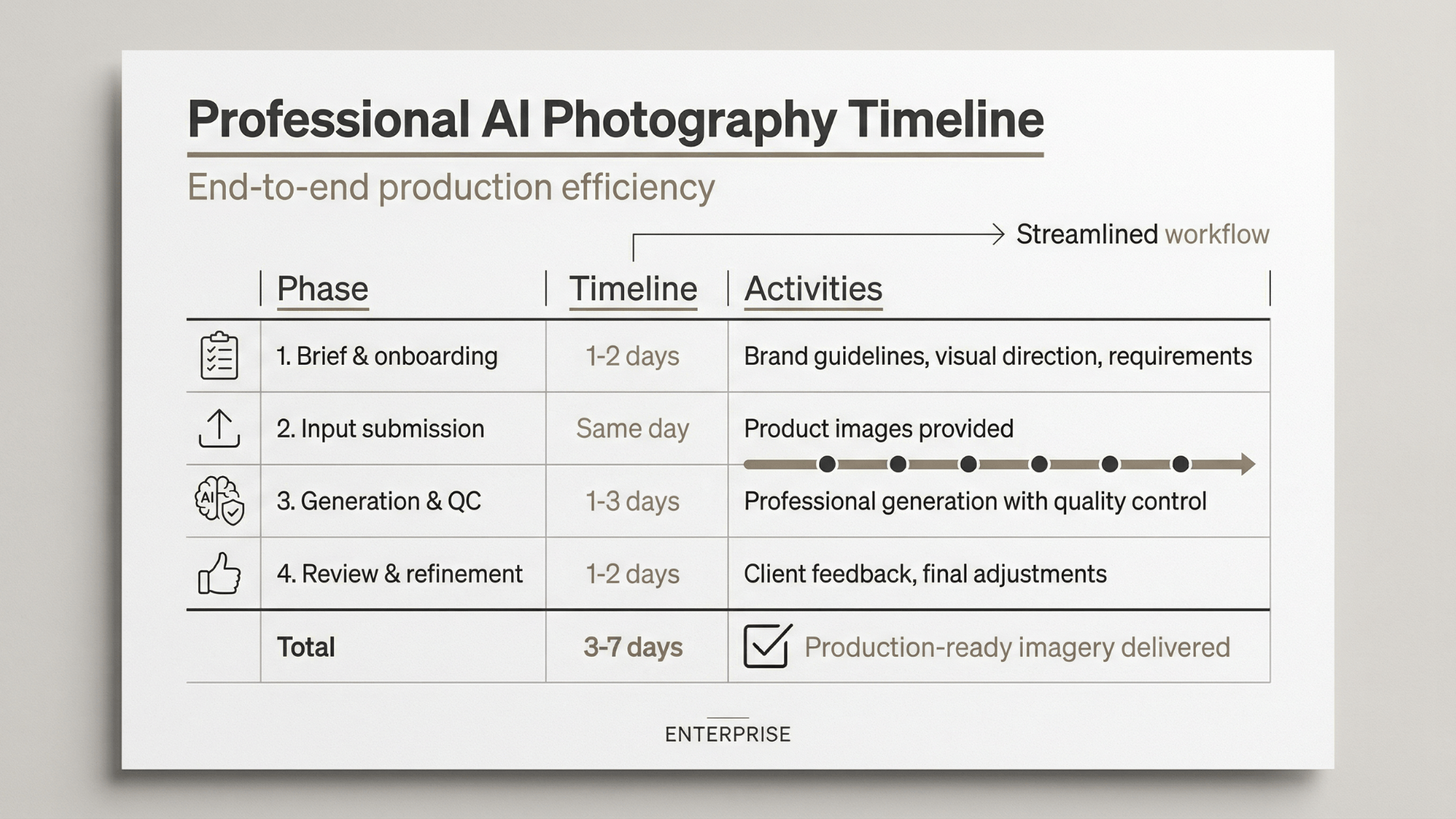
Professional services compress the timeline while eliminating the quality uncertainty.
For urgent needs, turnaround can drop to 24-48 hours—without sacrificing consistency.
Quality Comparison: The Uncomfortable Truth
Two years ago, the quality gap between AI and traditional photography was obvious.
Today, the gap has shifted. Professional AI photography can match traditional quality for e-commerce applications.
But DIY AI outputs? Still obvious. Still damaging.
What Professional AI Photography Achieves
Product detail pages (PDPs): Clean, consistent catalogue imagery across thousands of SKUs. Professional colour accuracy. Realistic fabric rendering. Poses that convert.
Model diversity at scale: Virtual models across different ethnicities, body types, and age groups. Representation without the logistical complexity of booking diverse talent for every shoot.
Variant generation: Same product, different contexts. Lifestyle backgrounds. Seasonal variations. Platform-specific crops. All maintaining brand consistency.
Speed to trend: When a product goes viral, you need imagery immediately. Professional AI delivers in days, not weeks.
Major brands including H&M, ASOS, Zara, and Mango now use professional AI photography services for significant portions of their product imagery.
H&M's April 2025 partnership with AI company Uncut created digital twins of 30 models for social media and advertising campaigns. This wasn't a DIY experiment—it was a strategic professional implementation.
Stradivarius launched an entire campaign created with professional AI photography in 2024, featuring imagery that "could reinvent fashion."
What DIY AI Tools Produce
Generic outputs lacking brand identity. Inconsistent lighting across your catalogue. Fabric rendering that triggers subconscious distrust. Poses that feel artificial.
The technology can produce quality results. But quality requires expertise.
Giving someone Photoshop doesn't make them a designer. Giving someone AI tools doesn't make them a photographer.
Where Traditional Photography Still Wins
Professional AI photography handles 80-90% of product imagery needs.
But some applications still demand traditional shoots:
Editorial storytelling. The best fashion campaigns create emotional connection. They capture energy, movement, and the feeling an image creates. This requires human creative vision.
Hero campaign imagery. Seasonal launches, brand campaigns, PR moments—these define your brand perception. The investment in traditional photography pays dividends in brand equity.
Celebrity and influencer content. If your campaign requires specific human recognition, traditional remains necessary.
Luxury heritage positioning. Brands trading on craftsmanship and authenticity may find that AI imagery—even professional AI imagery—conflicts with their positioning.
The smart approach isn't AI versus traditional. It's knowing which to use when.
The Hybrid Model: What Actually Works
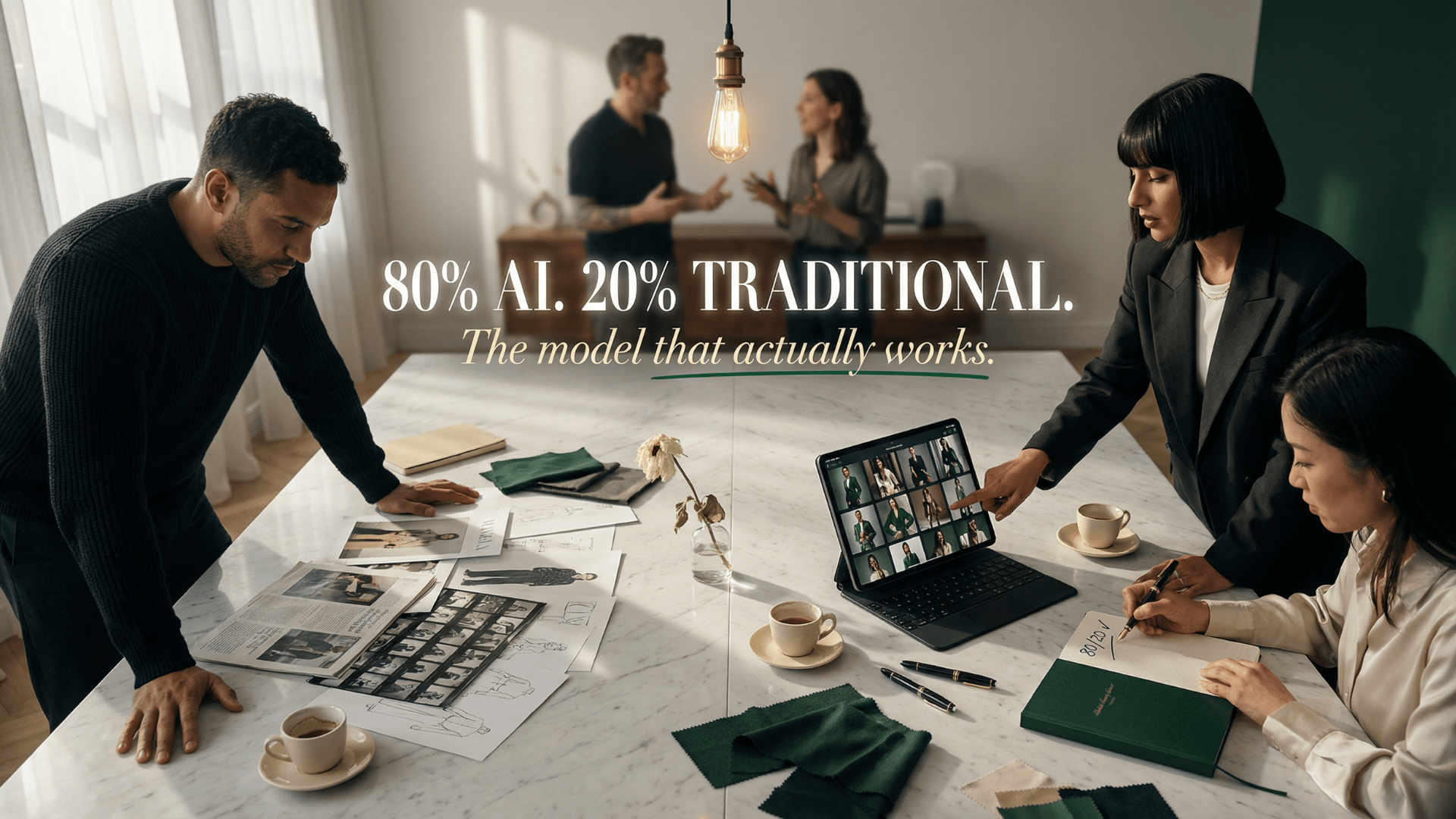
The brands winning in 2026 aren't choosing sides. They're deploying both strategically.
The 80/20 Split
Most successful fashion brands use traditional photography for 10-20% of content and professional AI photography for 80-90%.
Traditional shoots handle:
- Hero images for seasonal campaigns
- Lookbook covers and brand manifesto content
- Editorial and PR imagery
- Content requiring specific artistic vision or celebrity talent
Professional AI photography handles:
- Product detail pages across full catalogues
- Variant generation for different platforms and markets
- Seasonal updates without reshooting existing products
- A/B testing different creative directions
- Rapid response to trending products
Why DIY Doesn't Fit This Model
The hybrid approach requires consistent quality across both methods.
Traditional photography delivers consistent quality because professionals control the process.
Professional AI photography delivers consistent quality because specialists manage the technology.
DIY AI tools deliver inconsistent quality because the expertise layer is missing.
Mixing professional traditional imagery with amateur AI outputs creates jarring inconsistency across your brand presence. Your hero campaign looks premium. Your product pages look budget.
The hybrid model only works when both components deliver brand-appropriate quality.
The Real Cost Comparison
Traditional photography costs are clear: $15,000-$50,000 per shoot.
DIY AI tools seem cheap on the surface.
But the real comparison requires accounting for total cost of ownership.
DIY AI Tools: Hidden Costs
Your time: Hours learning the tool. Hours generating and reviewing outputs. Hours fixing inconsistencies.
Lost conversions: 18-26% conversion rate reduction from inconsistent imagery adds up fast on any meaningful revenue base.
Brand damage: Quantifying brand perception damage is difficult. Recovering from it is expensive.
Re-work: When DIY outputs don't meet standards, you either accept lower quality or pay for traditional photography anyway.
Professional AI Photography: Total Value
Predictable costs: Project-based or retainer pricing with defined deliverables.
No hidden time investment: You submit products, receive finished imagery.
Conversion optimisation: Professional quality maintains or improves conversion rates.
Brand consistency: Visual identity remains intact across your catalogue.
Scale efficiency: Cost per image decreases as volume increases.
The question isn't which option costs less per month. It's which option delivers profitable results.
Making the Decision: A Framework
Choose Traditional Photography When:
- Hero campaign imagery needs emotional storytelling
- Brand positioning depends on authenticity and craftsmanship
- Celebrity or influencer recognition is required
- Editorial coverage for PR purposes
- Luxury positioning where process matters to customers
Choose Professional AI Photography When:
- Large catalogues (50+ SKUs) require consistent imagery
- Speed to market is critical for your business model
- You need multiple variants for different platforms and markets
- Diversity and representation goals require broad demographic coverage
- Scaling content production without proportionally scaling costs
Avoid DIY AI Tools When:
- Brand perception matters to your business
- Consistency across your catalogue affects conversion
- You lack internal expertise in AI image generation
- Quality control resources are limited
- Your time has value
The Exception for DIY
DIY AI tools have legitimate use cases:
- Internal testing and concepting before professional production
- Very early-stage brands with zero budget and high risk tolerance
- Technical teams with genuine AI expertise
- Non-customer-facing applications
For customer-facing product imagery where conversion and brand perception matter, professional solutions deliver the results that justify the investment.
What This Means for Fashion Brands
The fashion photography landscape has permanently shifted.
Traditional photoshoots remain essential for strategic creative moments. But the economics no longer support traditional photography for entire catalogues.
AI photography fills the gap—when implemented professionally.
The brands succeeding with AI photography aren't the ones who found the cheapest tool. They're the ones who found the right expertise.
The question isn't whether to adopt AI photography. It's whether you'll implement it in a way that elevates your brand or damages it.
Frequently Asked Questions
How much does professional AI fashion photography cost compared to traditional?
Professional AI photography services typically deliver 70-90% cost savings compared to traditional photoshoots while maintaining comparable quality for e-commerce applications. Traditional shoots run $15,000-$50,000 per session. Professional AI services vary based on volume and requirements but deliver significant efficiency gains at a fraction of traditional costs.
Can AI photography completely replace traditional fashion photoshoots?
For e-commerce product imagery, professional AI photography can replace 80-90% of traditional photography needs. Hero campaigns, editorial content, celebrity imagery, and luxury brand positioning often still benefit from traditional photography's emotional storytelling and authenticity.
What's the difference between DIY AI tools and professional AI photography services?
DIY tools provide the technology without the expertise. You handle input preparation, prompt engineering, quality control, and post-processing. Professional services combine AI technology with creative direction, brand consistency management, and quality assurance—delivering production-ready imagery without requiring your team to develop new technical skills.
How long does professional AI fashion photography take?
Professional AI photography services typically deliver production-ready imagery in 3-7 days from brief to final delivery. For urgent needs, turnaround can compress to 24-48 hours. This compares to 6-8 weeks for traditional photoshoots.
Which fashion brands are using professional AI photography?
H&M, Stradivarius, ASOS, Zara, Mango, and numerous DTC brands use professional AI photography for product imagery. H&M's April 2025 digital twins initiative and Stradivarius's 2024 full-AI campaign represent high-profile implementations.
What quality level can professional AI fashion photography achieve?
Professional AI photography now produces imagery virtually indistinguishable from traditional photography for e-commerce applications. The gap between professional AI outputs and DIY tool outputs, however, remains significant.
Does AI fashion photography work for luxury brands?
Luxury brands face a positioning consideration. While professional AI photography can deliver quality, brands emphasising craftsmanship and heritage must evaluate whether AI imagery aligns with their brand narrative. Many luxury brands use AI for internal testing and variant generation while maintaining traditional photography for customer-facing content.
How do I evaluate professional AI photography services?
Assess portfolio consistency across large catalogues, not individual hero images. Ask about quality control processes. Request references from fashion brands at similar scale. Evaluate whether their creative approach aligns with your brand positioning.
Last updated: February 2026
Fashion NUT provides professional AI photography solutions for fashion brands through GENLOOK Studio