

TL;DR: Prompt Commerce is Fashion NUT's methodology for making fashion brands discoverable inside AI conversations. Instead of optimising for Google keywords, you optimise for the questions real shoppers ask ChatGPT, Perplexity, and Claude. Brands that do this get recommended. Brands that don't become invisible.
The Search Bar Is Dying
Think about how you used to find a dress for a wedding.
You opened Google. You typed "midi dress wedding guest." You clicked through six tabs. You compared prices. You eventually bought something.
That journey is over.
Today, 60% of consumers use AI for shopping decisions. They're not typing keywords. They're having conversations.
"I need something for my best friend's outdoor wedding in June. It's boho-themed, I'm a size 12, and I don't want to spend more than $250."
That's a prompt. Not a keyword.
And if your brand isn't optimised for that prompt, the AI won't recommend you. Simple as that.
What is Prompt Commerce?
Prompt Commerce is the practice of making your fashion brand visible, credible, and recommendable inside AI-powered conversations.
It is not SEO. It is not social media marketing. It is not paid ads.
It is a new discipline built specifically for the way people shop in 2026.
Here's how it works.
When a shopper asks an AI assistant for a recommendation, the AI searches its knowledge base. It looks for brands with clear, structured, authoritative information. Brands with rich product data. Brands that appear in trusted sources. Brands the AI has "heard of."
If your brand checks those boxes, you get recommended.
If it doesn't, you don't appear at all.
Prompt Commerce is the system Fashion NUT developed to make sure fashion brands check every box.
Why Fashion Brands Have a Bigger Problem Than Other Industries
Selling a laptop on AI is straightforward. The specs are clear. RAM, storage, battery life. AI can compare those easily.
Fashion is different.
AI needs to understand fit. Fabric. Occasion. Aesthetic. Body type compatibility. Price perception. Brand personality.
"Best oversized blazer for a petite woman who wants to look powerful in client meetings but not overdressed on a Friday" is a fashion prompt.
That prompt contains seven distinct signals. Most fashion brands don't have structured data that answers even three of them.
This is the fashion-specific challenge Prompt Commerce solves.
Prompt Commerce for Fashion: The Framework

This is Fashion NUT's proprietary methodology. It maps how fashion shoppers express intent in AI prompts, and what brands need to do to appear in the answer.
There are three pillars.
Pillar 1: Prompt Presence
This is your brand's foundation layer.
AI systems need to know you exist. They need consistent, accurate, structured information about who you are and what you sell.
This means your brand name is the same everywhere. Your product descriptions are detailed and attribute-rich. Your website is crawlable and structured for AI indexing.
Without Prompt Presence, nothing else works. You're invisible before you even start.
Pillar 2: Prompt Shelf
This is where most brands should be winning right now. Almost none are.
The Prompt Shelf is your brand's positioning inside specific AI queries.
Shoppers aren't asking "women's tops." They're asking:
- "Relaxed linen top for a beach holiday, size 16, under $75"
- "Workwear blouse that doesn't look corporate, small, under $100"
- "Anniversary dinner outfit that looks expensive but isn't"
Each of those is a shelf. Your brand either sits on it or it doesn't.
Owning the Prompt Shelf means identifying the 30 to 50 real queries your ideal customer is asking AI right now. Then making sure your product data, content, and brand signals answer every single one of them.
Pillar 3: Prompt Authority
This is the trust layer.
AI systems cite sources. They favour brands that appear in reputable publications, industry reports, and community discussions. They trust brands with consistent entity recognition across the web.
Prompt Authority is built through PR mentions, structured schema markup, Wikipedia and Wikidata presence, third-party reviews, and content that AI systems quote when answering questions.
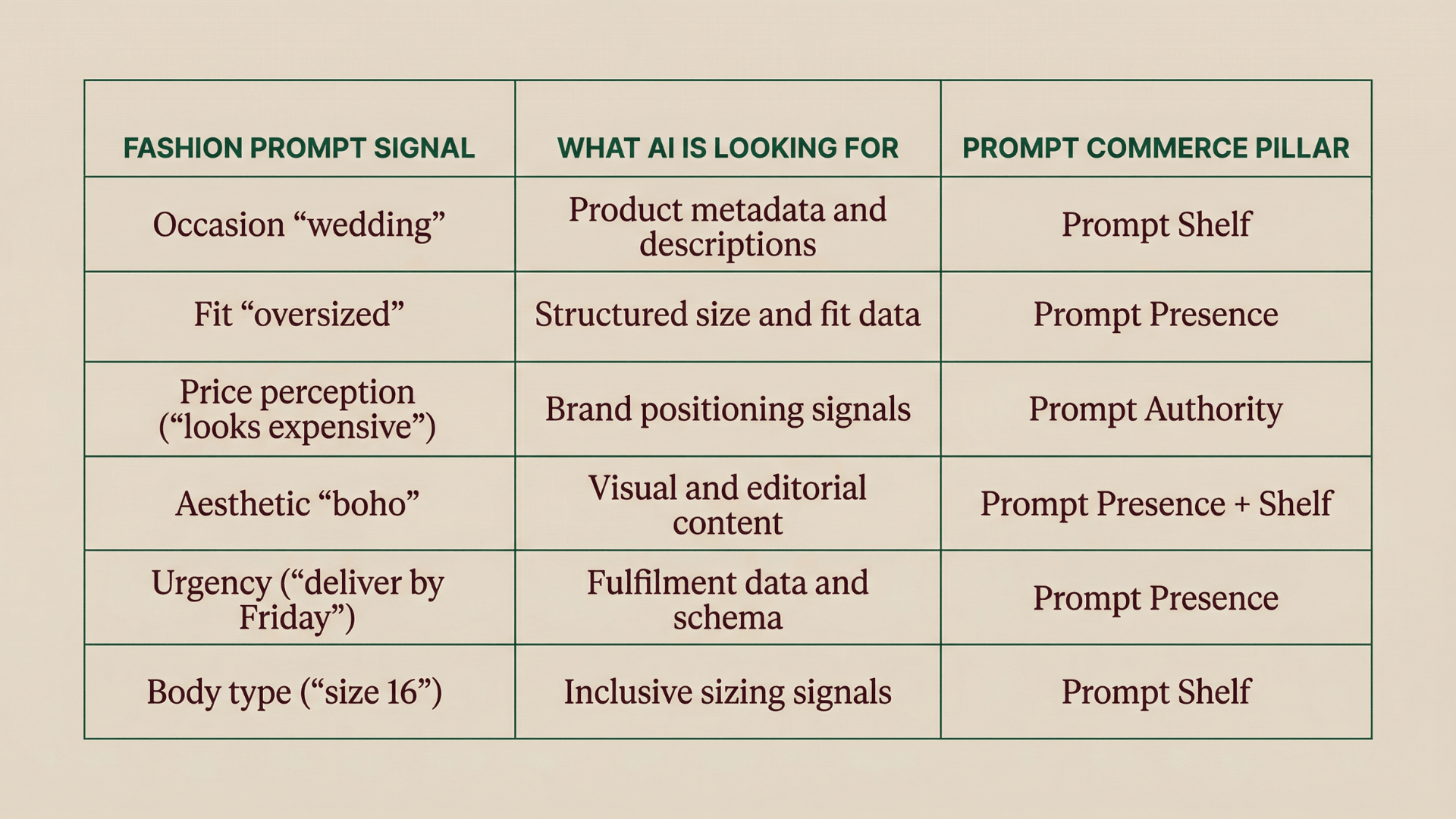
Here's how the three pillars map to what AI needs:
How Prompt Commerce Differs From SEO and GEO
A lot of brands confuse these three things. They are not the same.
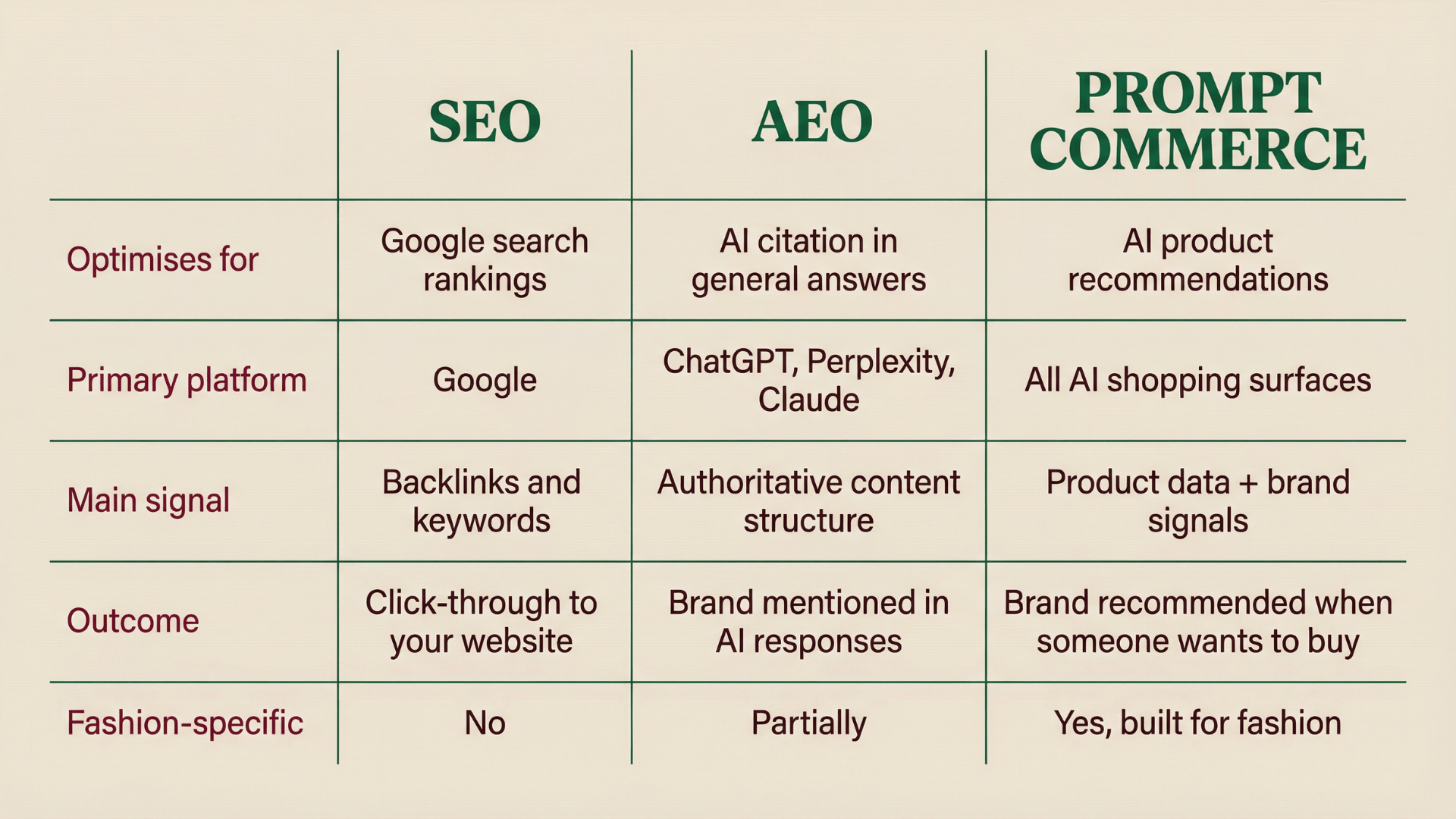
The verdict: You need all three. But Prompt Commerce is the only one built around purchase intent. It's the one that converts.
What This Looks Like in Practice
A Menswear Brand
A customer asks ChatGPT: "Smart casual blazer for a tall guy, something that works for both office and weekend, under $350."
A brand with Prompt Commerce in place has:
- Product titles that include "smart casual," "tall fit," and occasion tags
- Editorial content that defines their aesthetic in natural language
- Structured data telling AI their size range includes tall fits
- Reviews and press mentions that reinforce quality at their price point
Result: they appear in the answer. Their competitor, who only has keyword-optimised product titles, does not.
A Lingerie Brand
A customer asks Perplexity: "Best supportive bralette for large bust, minimalist style, something I can wear under sheer tops."
A brand with Prompt Commerce in place has:
- Size and support attributes clearly structured in product data
- Content that uses the exact language customers use ("large bust," "sheer top compatible")
- Entity recognition that tells AI they specialise in this category
Result: they get recommended alongside established names. A brand without this is invisible.
A Luxury Brand
A customer asks Claude: "I want to buy my wife something for our anniversary. She loves quiet luxury, classic pieces, not logo-heavy. Budget around $600."
This is almost entirely about brand signals, not product specs.
A brand with Prompt Commerce has built the right authority signals. AI knows their positioning. It has seen them referenced in the right publications. It understands what "quiet luxury" means for this brand.
Result: they appear in the recommendation. A brand with no Prompt Authority is simply not in the conversation.
The Prompt Commerce Audit
Ask yourself these five questions right now.
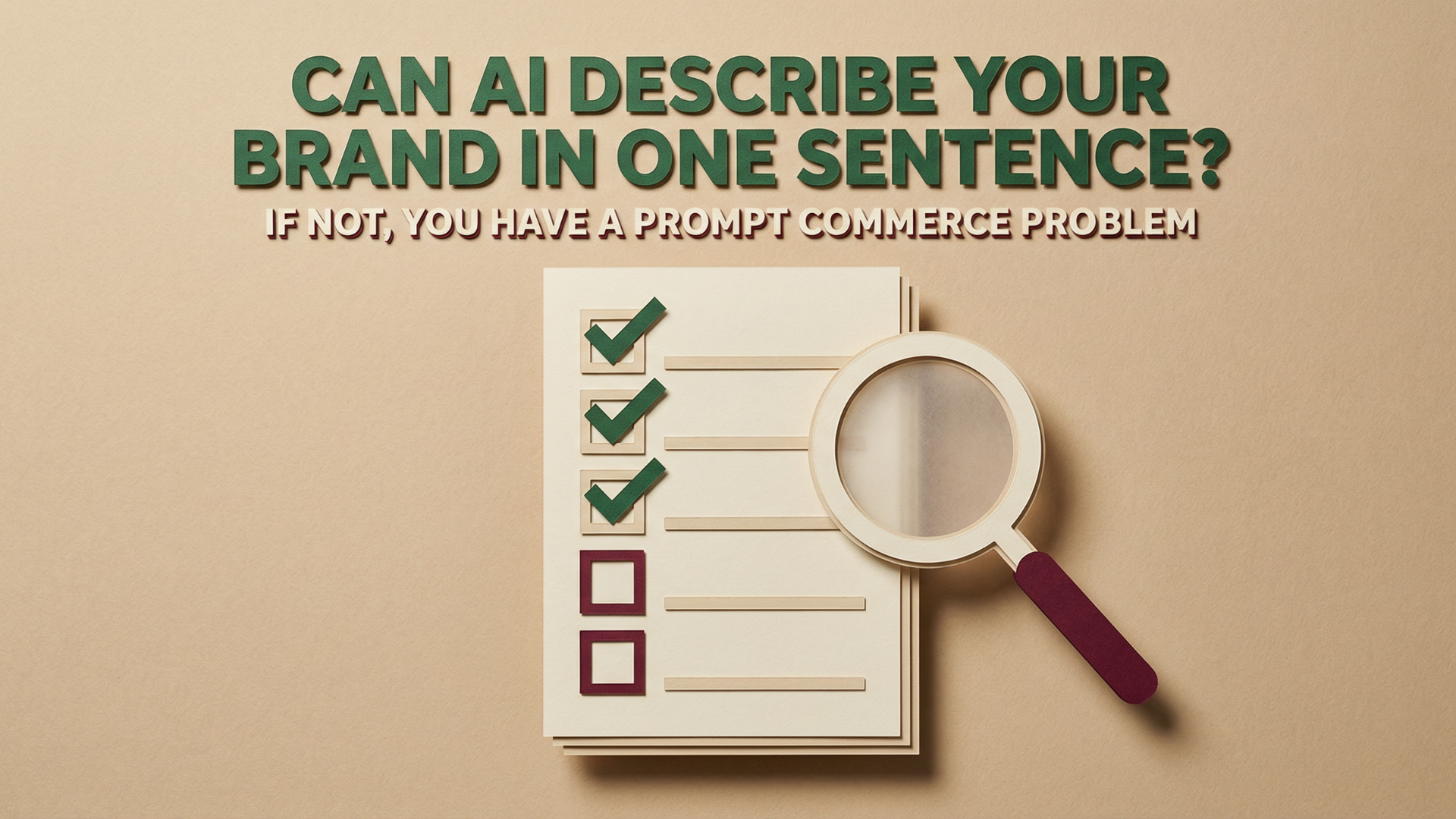
1. Can an AI describe your brand in one sentence?Search ChatGPT or Perplexity for your brand name. What comes back? If the answer is vague or wrong, your Prompt Presence needs work.
2. Do your product descriptions contain occasion, fit, and aesthetic signals?Not just "blue midi dress." But "relaxed navy midi dress, ideal for summer weddings, flattering for hourglass figures, hits below the knee."
3. Have you mapped the 30 queries your customer is asking AI?Not guessing. Actually testing. Open ChatGPT. Ask the questions your customer would ask. Does your brand appear?
4. Does your brand appear in trusted third-party sources?Press coverage, industry reports, community discussions. AI needs external validation to trust you.
5. Is your schema markup complete?Product schema, Organisation schema, FAQPage schema. This is the technical layer that tells AI crawlers exactly what you sell and who you are.
If you answered no to three or more of these, your brand is invisible to AI shoppers right now.
Why This Matters More in Fashion Than Anywhere Else
Fashion is personal. The stakes are high. Getting a recommendation wrong loses a customer forever.
AI systems know this. They are more cautious with fashion recommendations than with any other category. They only recommend brands they trust.
That trust is built through Prompt Commerce.
The brands building it now will own AI shelf space for years. The brands ignoring it will be paying to reclaim visibility later.
Just like organic reach on Instagram. Just like SEO in 2010.
The shelf is open right now. It will not stay open.
Next Steps
If you want to know where your brand stands, start with the audit above.
If you want Fashion NUT to run it for you, that's what our Prompt Commerce service does. We map your current AI visibility, identify the gaps, and build the data and content infrastructure to close them.
The conversation is already happening. The only question is whether your brand is in it.
Last updated: February 2026Author: Tam Sood, Fashion NUTCategory: Prompt Commerce, AI Discovery, Agentic CommerceRead time: 8 minutes
Frequently Asked Questions
What is Prompt Commerce?Prompt Commerce is Fashion NUT's methodology for making fashion brands discoverable and recommendable inside AI-powered conversations. It covers product data structure, brand signals, and content optimisation specifically for how AI shopping assistants work.
Is Prompt Commerce the same as SEO?No. SEO optimises for Google keyword rankings. Prompt Commerce optimises for AI product recommendations. The signals, platforms, and outcomes are different. You need both, but they serve different purposes.
Which AI platforms does Prompt Commerce work on?ChatGPT, Perplexity, Claude, Google AI Overviews, and any AI assistant with shopping or recommendation capability. The methodology applies across all platforms because the underlying signals AI uses are consistent.
How long does it take to see results from Prompt Commerce?Entity recognition and basic visibility improvements can appear within 4 to 8 weeks of implementation. Building full Prompt Authority through content and third-party signals typically takes 3 to 6 months.
Does Prompt Commerce work for small fashion brands?Yes. In fact, smaller brands have an advantage. The AI shelf is not yet owned by anyone. A niche brand with excellent Prompt Commerce in place can appear alongside much larger competitors for the right queries.
What is the difference between Prompt Presence, Prompt Shelf, and Prompt Authority?Prompt Presence is your foundation: making sure AI knows who you are. Prompt Shelf is your positioning: making sure you appear for the right purchase queries. Prompt Authority is your trust layer: making sure AI is confident enough to recommend you.